Editor’s note: this is a developing story. Last updated June 5, 2026.
Since this article first published, Connecticut’s convertible pistol bill has been signed into law. It is now Public Act No. 26-41, signed May 26, 2026, with all provisions taking effect October 1, 2026. Several questions discussed below are still genuinely unsettled, including whether specific Glock Gen 6 and V-series models satisfy the statutory exemption, and exactly which non-Glock pistols fall under the law’s “cruciform trigger bar” definition. As of this update, Connecticut has not issued interpretive guidance and no court has ruled. We treat this as a living explainer and update it as the picture develops, so the details below reflect our best current understanding and may change.
The “Glock ban” shorthand has been circulating widely since Connecticut’s House of Representatives voted 86-64 on April 22, 2026, to pass new restrictions on a specific class of semiautomatic pistol. The shorthand is wrong in two directions at once, and understanding why matters for anyone who owns a pistol in Connecticut, does business there as a licensed firearms dealer, or is simply trying to follow what’s happening as similar legislation moves through other state legislatures.
The Connecticut law does not ban all Glocks. It does not ban all striker-fired pistols. It does not require current owners to register or surrender anything. What it does is considerably more precise: it targets a specific internal geometry, the cruciform trigger bar, that makes certain semiautomatic pistols uniquely susceptible to conversion to full-auto fire via an accessory already illegal under federal law.
Not Quite a “Glock Ban”
The statute defines a “convertible pistol” as any semiautomatic pistol with a cruciform trigger bar that can be readily altered by hand or with a common household tool to be converted to a machine gun by the installation of a pistol converter. The cruciform trigger bar is defined in the bill text as “a component in a semiautomatic pistol that serves as a linkage between the trigger and firing pin and has its sear incorporated in a cross-shaped surface”.
That cross-shaped geometry is the specific anatomical detail the legislation targets. It is not the Glock brand. It is not the striker-fired operating system as a category. It is that particular geometry, which happens to be a design characteristic shared across Glock’s traditional lineup and a number of other pistols built on the same trigger-bar geometry. Some striker-fired handguns from other manufacturers use different trigger bar designs and may fall outside this definition. Others that share the Glock-pattern fire control, such as certain Ruger RXM or Shadow Systems models, could be captured by it. Exactly which non-Glock models the definition reaches is still being worked through, and a pistol should not be assumed clear simply because it is not a Glock.
Two categories of pistols are explicitly excluded from the “convertible pistol” definition. First, any hammer-fired semiautomatic pistol: the Beretta 92 series, the CZ 75, the 1911 pattern, and similar designs are entirely outside the scope of this law, because their operating mechanisms do not interact with pistol converters in the same way. Second, any pistol fitted with “a tab or other piece of material that shields the cruciform trigger bar from interference by a pistol converter” is also excluded. That second exemption is the language Glock designed toward, and it is where most of the remaining uncertainty lives.
How a Pistol Switch Actually Works
A pistol converter, commonly called a Glock switch or machine gun conversion device, installs at the rear of the slide where the backplate normally sits. It functions as an auto sear: once in place, it holds the striker in the cocked position independent of the trigger bar’s reset cycle. After the first round fires, the recoil cycle recocks the striker, and the switch releases it automatically, enabling continuous fire from a single sustained trigger pull.
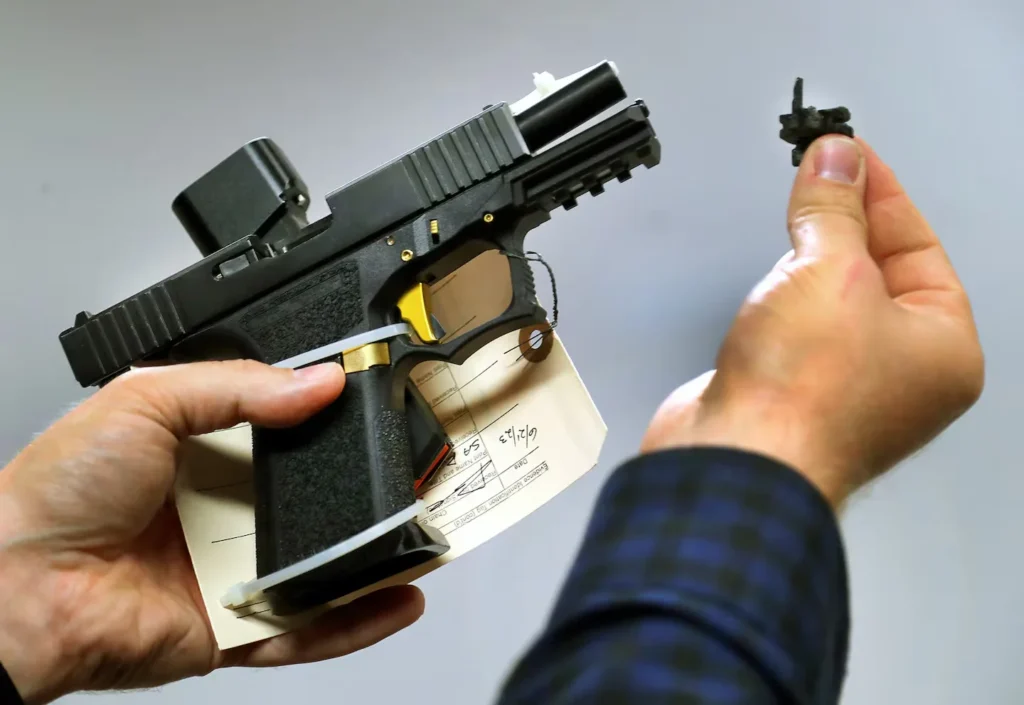
The cruciform trigger bar’s cross-shaped sear surface is the precise geometry this exploit bridges. Because the front of a Glock’s cross-shaped sear surface is exposed in a specific way at the rear of the slide, a switch designed for that geometry can be installed in minutes with basic tools. Pistols using different trigger bar configurations do not offer the same access point, which is why switches engineered for Glock-pattern pistols generally do not function on, for example, a Sig Sauer striker system or a Smith & Wesson M&P.
It is worth being direct about something the coverage has often buried: pistol converters are already illegal under federal law. They constitute unregistered machine gun conversion devices under the National Firearms Act. Connecticut’s law does not make switches more illegal; it removes from commerce the pistols most readily converted by them. The regulatory logic is to address the hardware the switches exploit, not the switches themselves.
What the Law Does and Doesn’t Cover
The practical scope of this legislation is narrower than the coverage has suggested, and understanding the carve-outs is as important as understanding what the ban actually covers.
The prohibition applies to commercial sale: knowingly importing into Connecticut, advertising, selling, or offering for sale any convertible pistol manufactured on or after October 1, 2026 is a Class D felony. The October 1, 2026 manufacture date is the operative boundary, not purchase date or possession date.
Here is what the law, as enacted, does not do:
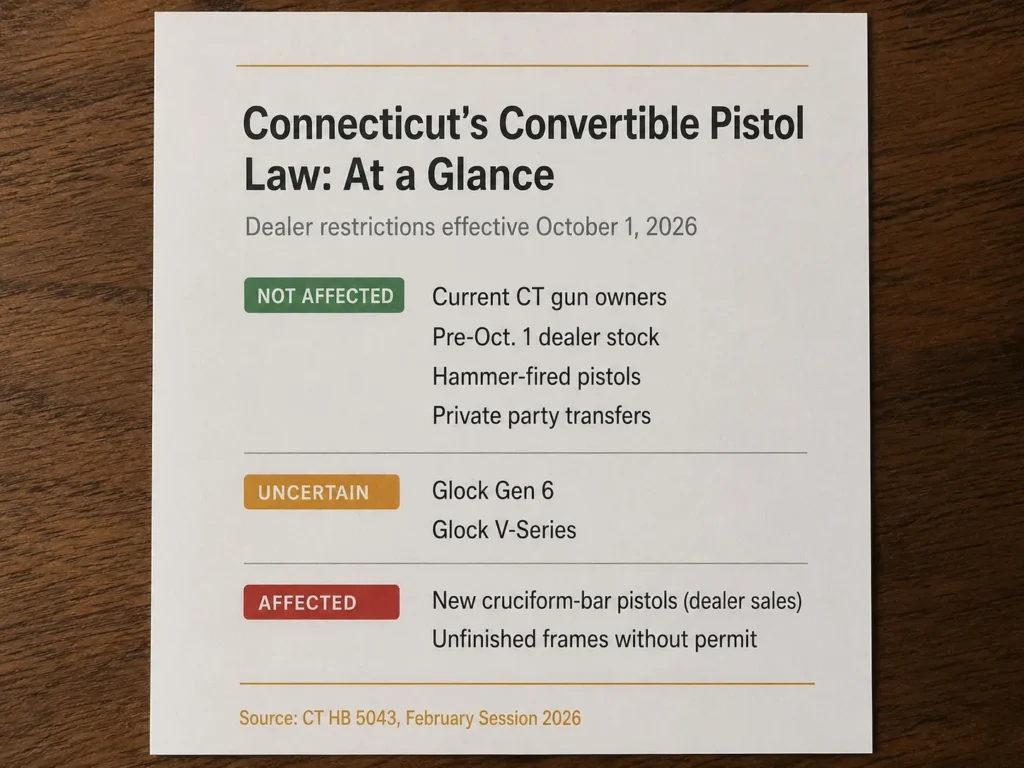
| Category | Status | Notes |
|---|---|---|
| Current Glock owner in CT | Not affected | No possession ban, no confiscation, no registration requirement |
| Dealer selling pre-Oct. 1, 2026 Glock stock | Likely not affected | Manufacture date controls; pre-cutoff inventory is not captured |
| Dealer selling a new Glock with cruciform trigger bar after Oct. 1 | Affected | Class D felony |
| Dealer selling Glock Gen 6 or V-series after Oct. 1 | Uncertain | FFL must make the compliance call; no state pre-certification list |
| Hammer-fired pistol (Beretta 92, CZ 75, 1911 pattern) | Not affected | Explicit statutory exemption |
| Private party transfer of a convertible pistol (non-dealer to non-dealer) | Not banned by this law | Public Act 26-41 (Sec. 3(b)) exempts non-dealer to non-dealer transfers. This does not make private handgun transfers dealer-free: Connecticut’s existing law still requires every handgun transfer to go through the state DESPP authorization process and a licensed dealer. |
| Selling unfinished frames or receivers without a state permit | Affected | Ghost gun provision; Class C felony |
No registration requirement was created. Connecticut’s Special Licensing and Firearms Unit, which processes assault weapon certifications and is already working through a significant backlog of applications, was not tasked with building a registry for convertible pistols.
Connecticut residents who already legally own a pistol with a cruciform trigger bar are not required to do anything. That possession remains lawful.
One point is worth making explicit, because it has caused confusion: the exemption for private, non-dealer transfers does not mean Connecticut lets firearms change hands privately without a dealer. Every handgun transfer in Connecticut, including a private sale or a gift, already has to run through the state’s DESPP authorization process and is handled by a licensed dealer under existing law. Public Act 26-41 does not change that, in either direction.
What Glock Did, and Why There’s Still Uncertainty
Glock’s response to this legislative environment was a substantial product line overhaul in 2026. The company phased out many Gen 3, Gen 4, and Gen 5 configurations and introduced two new product lines: the V-series, which uses a redesigned trigger bar geometry that departs from the traditional cruciform design, and Gen 6, which retains existing model designations but incorporates redesigned internals, including a physical tab or shield element at the rear of the slide intended to block converter installation.
The Gen 6 design is precisely calibrated toward the law’s second exemption: the “tab or other piece of material that shields the cruciform trigger bar.”
The uncertainty, and it is real, centers on two unresolved questions.
First, whether the Gen 6 shield design is sufficient to satisfy the statute. The law provides no pre-certification process and no banned-by-name list. Compliance determination falls on licensed firearms dealers, not on Glock or the state of Connecticut to confirm in advance. Each FFL selling a Gen 6 in Connecticut after October 1 is making a legal judgment call about whether that specific pistol’s tab or shield “shields the cruciform trigger bar from interference by a pistol converter” within the meaning of the statute.
Second, the exemption language contains a built-in vulnerability: the tab or shield must be effective enough that the pistol cannot “readily” be converted despite it. Critics, including gunsmiths and independent security researchers, have argued that new switch variants can be engineered to defeat the Gen 6 shield within days of its release. If that argument prevails, a Gen 6 unit might not qualify for the exemption, because a converter could still “readily” convert it. This is contested, and the data is not yet there.
The honest answer for any dealer operating in Connecticut is that the Gen 6’s exemption status will not be definitively resolved until either a court weighs in or the state issues interpretive guidance. Neither has happened yet.
The Ghost Gun Provision
Connecticut’s convertible pistol law also includes a separate set of provisions expanding the definition of “unfinished frame or unfinished lower receiver.” The prior definition in Connecticut law used percentage-based language. The new version captures any item that “has reached a stage in manufacture where it may readily be completed into the frame or receiver of a functional firearm” or that is “marketed or sold to the public to become or be used as the frame or receiver of a functional firearm once completed”.
This is a meaningful expansion. Rather than requiring regulators to assess what percentage complete a given blank or casting is, the new standard asks whether an item is functionally or commercially oriented toward becoming a functional receiver. The penalty for violations is a Class C felony, carrying a mandatory minimum of two years and a $5,000 fine. Selling a stolen or serial-number-obliterated unfinished receiver elevates to a Class B felony with a three-year mandatory minimum and a $10,000 fine.
Dealers selling any unfinished frames or receivers in Connecticut will need a state retail firearms permit under a separate provision of the same law. This provision operates independently of the convertible pistol sections and affects a different, though sometimes overlapping, segment of the dealer population.
Where This Goes Next

The bill was signed into law on May 26, 2026 as Public Act No. 26-41, after passing the House 86-64 on April 22 and clearing the Senate in early May. All provisions take effect October 1, 2026, leaving dealers a defined window before the manufacture-date threshold becomes operative.
The legislative strategy Connecticut is using is not unique to Connecticut. Maryland has been fast-tracking similar legislation targeting the same cruciform trigger bar design. Reports suggest comparable bills are being tracked or advanced in other states, though the specifics of those measures vary and the picture is incomplete as of this writing. The consistent pattern across states that have moved on this is targeting the pistol geometry rather than the switch itself, or Glock as a named brand.
Whether the V-series and Gen 6 redesigns satisfy the relevant exemptions in each state will vary by how each statute is written. The Connecticut statute’s language is the most specific currently available, but it leaves enough interpretive room that dealers and attorneys are likely to reach different conclusions until courts or regulators provide clarity.
For Connecticut gun owners who currently possess a Glock or similar pistol: nothing in this law, as enacted, requires any action on your part. Your existing firearm remains legal to own.
For Connecticut-based dealers and out-of-state dealers who ship to Connecticut buyers: the October 1, 2026 manufacture date is the operational date to track. The compliance picture for Gen 6 and V-series models is unresolved, and it is worth consulting directly with legal counsel and your FFL compliance resources before making inventory decisions predicated on those models satisfying the exemption.
For anyone following the multi-state picture: the Connecticut General Assembly’s website publishes the enacted Public Act and will post any future amendments or related guidance. Reading the statute directly is the most reliable way to track changes before and after the effective date.
Legal disclaimer. This article is provided by Target Sports USA for general informational and educational purposes only. It is not legal advice and is not a substitute for the text of the law or for advice from a licensed attorney. Reading it creates no attorney-client or advisor relationship of any kind.
Firearms laws change frequently and are subject to interpretation, amendment, and legal challenge. Public Act 26-41 is newly enacted and parts of it remain unsettled, so portions of this article may become outdated or may later prove incomplete or inaccurate. The information is presented “as is,” with no warranty as to accuracy or completeness.
Any action you take based on this article is taken at your own risk. Before buying, selling, transferring, or making any compliance or business decision involving a firearm in Connecticut, verify the current law against the official statute (Public Act 26-41 and the Connecticut General Statutes) and consult a qualified Connecticut attorney, your licensed firearms dealer, and the Connecticut Department of Emergency Services and Public Protection (DESPP). Target Sports USA, its authors, and its affiliates assume no liability for any loss, damage, or legal consequence arising from reliance on this content.
Frequently Asked Questions
No. The law does not ban all Glocks, and it does not ban all striker-fired pistols. It targets a specific internal geometry called the cruciform trigger bar, a cross-shaped sear component that makes certain semiautomatic pistols susceptible to illegal machine gun conversion devices. Glocks using a redesigned trigger bar (the V-series) or a converter-blocking tab or shield (Gen 6) may qualify for a statutory exemption, though whether they satisfy that exemption is currently unresolved and falls to individual licensed dealers to determine.
No. The law, now enacted as Public Act 26-41, creates no possession ban, no registration requirement, and no confiscation or surrender obligation for existing owners. Connecticut residents who legally own a pistol with a cruciform trigger bar are not required to take any action. The prohibition applies to commercial sale, specifically to importing, advertising, selling, or offering for sale convertible pistols manufactured on or after October 1, 2026.
A cruciform trigger bar is a component inside certain semiautomatic pistols, most prominently Glock-pattern pistols, that links the trigger to the firing pin. Its cross-shaped sear surface is the specific geometry that makes these pistols uniquely vulnerable to machine gun conversion devices (commonly called Glock switches). A switch engineered for that geometry can be installed at the rear of the slide and enable fully automatic fire. That is the regulatory target of the Connecticut law.
That is currently unresolved. Glock redesigned both product lines specifically to address legislative concerns: the V-series eliminates the cruciform trigger bar entirely, and the Gen 6 incorporates a tab or shield intended to block converter installation, matching the statute’s exemption language. However, the law does not include a pre-certification process or a banned-by-name list. Compliance determination falls on each licensed dealer individually. Whether the Gen 6 shield is sufficient to satisfy the exemption will not be definitively settled until a court rules or the state issues interpretive guidance.
All provisions take effect October 1, 2026. The bill passed the House 86-64 on April 22, 2026, cleared the Senate in early May, and was signed into law on May 26, 2026 as Public Act No. 26-41. The operative boundary for dealers is the manufacture date of the pistol: any convertible pistol manufactured on or after October 1, 2026 falls under the prohibition.
Sources
- Connecticut Public Act No. 26-41 (Substitute House Bill No. 5043), signed May 26, 2026, effective October 1, 2026 (Connecticut General Assembly)
- Connecticut General Assembly, HB 5043 bill status and history
- WBOC Maryland (cruciform trigger bar mechanism explanation; Glock switch function).
- Police & Security News (March 2026, Glock lineup overhaul)

Kailon Kirby covers the ammunition market for Target Sports USA, where he has a view most writers never get. Working inside one of the country's largest online ammo retailers, he tracks pricing movements, supply conditions, and brand-level shifts as they happen, not after the fact.
A Connecticut State Pistol Permit and Concealed Carry holder, Kailon isn't just watching the numbers. He shoots, he carries, and he understands what market changes actually mean for the person standing at the counter or checking out online. That combination of ground-level industry access and shooter perspective is what shapes everything he writes.
When something is moving in the ammunition market, Kailon is usually the first to see it.
- Kailon Kirby
- Kailon Kirby
- Kailon Kirby

- Kailon Kirby