These two calibers share a bullet diameter of roughly .355 inches and a semi-automatic pistol platform. That is where the similarity ends. The 9mm Luger and the 10mm Auto sit at opposite ends of the practical pistol spectrum: one built for volume, accessibility, and competitive use; the other built for power, and worth it when power is what you actually need.
If you are deciding between the two for range training, competition, or hunting, here is the honest breakdown.
The direct answer on power: Yes, the 10mm Auto delivers significantly more muzzle energy than the 9mm Luger. A standard 180gr 10mm FMJ load produces roughly 575 ft-lb at the muzzle compared to approximately 327 ft-lb for a 124gr 9mm FMJ. The trade-off is more recoil, higher cost per round, and fewer compatible pistol platforms.
What the 9mm Luger Gives You at the Range
The 9mm Luger is the dominant training and competition caliber in the United States for straightforward reasons: it is widely available, cost-effective at volume, and manageable to shoot for extended sessions.
9mm Luger Wins For: high-volume training, competition, cost per round, platform breadth, recoil management
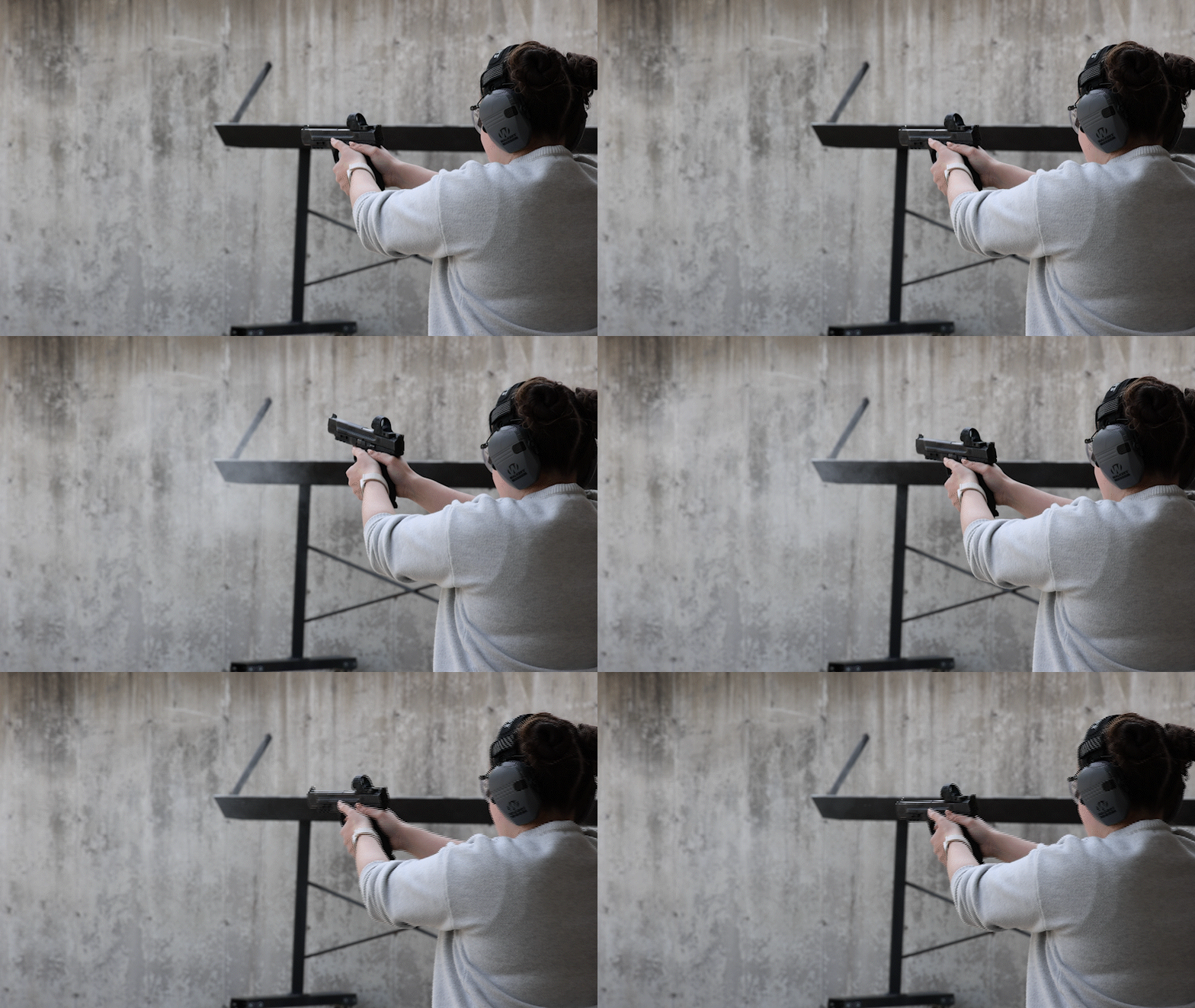
From a ballistics standpoint, 115gr FMJ loads run between 1,135 fps and 1,190 fps at the muzzle, producing 329 to 362 ft-lb of muzzle energy. The 124gr FMJ, which many range shooters prefer for a slightly heavier training load, runs around 1,090 fps and 327 ft-lb. Both weights are well-suited to punching cardboard, running drills, and training for competition.
Recoil is mild, in the range of 4 to 8 ft-lb of free recoil energy. Follow-up shots are fast, muzzle flip is minimal, and fatigue accumulates slowly over long sessions. If you are running 200 rounds or more on a range day, 9mm lets you run the full session without your technique breaking down toward the end.
Platform availability is nearly unlimited. Hundreds of pistol models across every major manufacturer, size category, and price point are chambered in 9mm, with proportionally deep aftermarket support for holsters, magazines, and sights. The Glock 17 and 19, the Sig Sauer P320, the CZ Shadow 2, the Walther Q5 Match: all 9mm, all well-supported.
For competitive shooting, 9mm is the practical standard. USPSA Production Division and IDPA Stock Service Pistol (SSP) are both heavily populated by 9mm pistols. USPSA’s official ammunition certification list includes extensive 9mm coverage. If competition is your primary use case, 9mm is not just an option; it is the caliber the game is built around.
Our roundup of the best 9mm range ammo covers the current field. The full 9mm Luger ammo selection lives on the main site.
What the 10mm Auto Gives You
The 10mm Auto gives you more of everything that matters ballistically, at a cost you need to account for.
10mm Auto Wins For: handgun hunting, energy ceiling, semi-auto capacity, range training for hunters
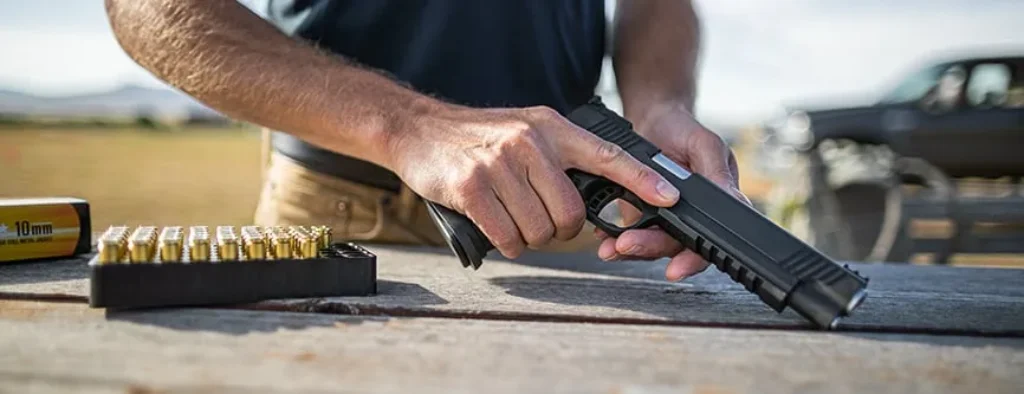
Full-power 180gr FMJ loads run from 1,030 fps to 1,250 fps depending on the specific load, producing 424 to 624 ft-lb of muzzle energy. That wide range is worth understanding: not all 10mm loads are equal. Federal American Eagle’s 180gr FMJ (AE10A) runs 1,030 fps and 424 ft-lb from a 5-inch barrel, while CCI Blazer Brass and Sig Sauer Elite loads in the same bullet weight reach 1,200 fps and 575 ft-lb, and 1,250 fps and 624 ft-lb, respectively. If you are comparing 10mm to 9mm, the higher-end 10mm loads are the relevant benchmark, not the reduced-power options.
The recoil is real. Full-power 10mm generates approximately twice the free recoil impulse of a standard 9mm load. Muzzle flip is pronounced, follow-up times increase, and an extended range session with 10mm requires a more deliberate grip and recoil management approach. The FBI adopted a reduced-power 10mm load in the late 1980s specifically because agents found the standard load’s recoil “objectionably strong.” That is not an argument against 10mm; it is context for managing expectations.
Platform selection is significantly narrower than 9mm. The most commonly available 10mm pistols include the Glock 20 Gen5, Glock 29, and Glock 40 MOS; the Sig Sauer P320-XTen and P220 Legion; the FN 510 Tactical; the Smith & Wesson M&P 2.0; the Springfield Armory XD-M Elite; and the Colt Delta Elite. The major training brands in this caliber, including Federal, CCI Blazer, Sig Sauer, and Winchester, are all available in 10mm Auto bulk packaging. The aftermarket depth of holsters, magazines, and parts does not approach what 9mm shooters have access to. Some 10mm pistols (like the Glock 20 and Sig Sauer P320-XTen) ship with 15+1 capacity; check your state’s magazine capacity laws before purchasing.
Ballistics Side by Side: Where the Difference Actually Shows
Here is how representative training loads from both calibers compare:
| Load | Bullet Wt. | MV (fps) | ME (ft-lb) |
|---|---|---|---|
| New Republic® 9mm FMJ (NR912450) | 124 gr | 1,090 | 327 |
| Federal American Eagle 9mm FMJ (AE9DP) | 115 gr | 1,180 | 356 |
| Winchester USA 9mm FMJ (Q4172) | 115 gr | 1,190 | 362 |
| Federal American Eagle 10mm FMJ (AE10A) | 180 gr | 1,030 | 424 |
| New Republic® 10mm FMJ Flat Nose (NR1018050) | 180 gr | 1,200 | 575 |
| Sig Sauer Elite 10mm FMJ (E10MB1-50) | 180 gr | 1,250 | 624 |
The energy gap between a standard 9mm training load and a full-power 10mm training load is roughly 200 to 300 ft-lb, depending on which loads you compare. The gap between a reduced-power 10mm load (like the AE10A) and the top-end 10mm loads is nearly as wide. If the energy ceiling matters to you, load selection within the 10mm family matters as much as the caliber choice itself.
10mm for Hunting: When the Extra Power Earns Its Keep
The 10mm’s legitimate appeal comes into clearest focus in the field. Multiple hunting and outdoor publications recognize it as a capable handgun hunting caliber for whitetail deer, feral hogs, antelope, and javelina at close to moderate range, typically 50 to 75 yards from a standard pistol. Optics-equipped long-slide platforms like the Glock 40 MOS can extend that range modestly toward 100 yards.
One important distinction: this hunting capability comes from expanding or hard-cast hunting loads, not from the FMJ training loads in the table above. Bulk FMJ is for the range. If you are planning a hunt, match the load to the application and work with hunting-specific projectiles.
MeatEater describes 10mm as a more capable hunting caliber than .45 ACP, citing its higher velocity and energy ceiling. For a hunter who already trains with a 10mm pistol, carrying that same platform into the field is a practical choice that keeps the training reps on the same trigger and controls.
Cost and Volume: The Range Math
This is where the 9mm vs. 10mm decision gets concrete for high-volume shooters.
Bulk 9mm FMJ runs approximately $0.22 to $0.28 per round. Bulk 10mm FMJ runs approximately $0.40 to $0.55 per round. That is roughly 1.8 to 2.3 times more expensive per round for 10mm. A shooter running 200 rounds per week spends, in round numbers, somewhere between $2,200 and $2,900 annually on 9mm, versus $4,200 to $5,700 on 10mm. The difference compounds across a year of training.
Which Caliber Should You Choose?
Choose 9mm if: You shoot at volume for training or competition. You want the widest possible platform and aftermarket selection. You compete in USPSA Production or IDPA SSP. You are building a training base and want to get reps without a significant per-session cost. Our best 9mm range ammo roundup goes deeper on load selection.
Choose 10mm if: You are a handgun hunter who wants a semi-automatic platform with real energy on target. You want your range platform and your hunting platform to be the same gun. You already have the platform and the technique to handle the recoil, and the higher per-round cost fits your training budget.
Both calibers have a clear, honest use case. The question is which use case matches yours.
Frequently Asked Questions
Yes. A standard 180gr 10mm FMJ load produces roughly 575 ft-lb of muzzle energy; a 124gr 9mm FMJ produces approximately 327 ft-lb. The 10mm also carries more velocity, which contributes to its hunting application. The trade-off is greater recoil, a narrower platform selection, and higher cost per round.
For most high-volume range shooters focused on drills and competition prep, no. The cost-per-round difference is substantial over a full year of training, and the added recoil makes rapid follow-up work harder. For shooters who hunt with a 10mm and want to train on their hunting platform, the answer is yes.
Brass-cased 180gr FMJ is the standard. The major training brands in 10mm — Federal American Eagle, CCI Blazer Brass, Sig Sauer Elite, and Winchester USA — all run brass-cased 180gr loads. New Republic’s NR1018050 (180gr FMJ Flat Nose, 1,200 fps, 575 ft-lb) sits at the higher-velocity end of that range.

Kailon Kirby covers the ammunition market for Target Sports USA, where he has a view most writers never get. Working inside one of the country's largest online ammo retailers, he tracks pricing movements, supply conditions, and brand-level shifts as they happen, not after the fact.
A Connecticut State Pistol Permit and Concealed Carry holder, Kailon isn't just watching the numbers. He shoots, he carries, and he understands what market changes actually mean for the person standing at the counter or checking out online. That combination of ground-level industry access and shooter perspective is what shapes everything he writes.
When something is moving in the ammunition market, Kailon is usually the first to see it.
- Kailon Kirby
- Kailon Kirby
- Kailon Kirby

- Kailon Kirby