We Read the Reviews So You Don’t Have To — All 135,000+ of Them
Deciding between a .38 Special and a 9mm? You’re really deciding between two philosophies of personal defense — and we have more receipts on this argument than anyone.
Having been in the ammo game for over 15 years here at Target Sports USA, we’ve watched the 9mm finish its conquest of American holsters while the .38 Special — the round that armed nearly every cop in this country for sixty years — quietly refused to retire. Our customers have left more than 143,000 verified reviews across these two calibers. That’s not a typo. The 9mm is our most-reviewed caliber, period, and the .38 Special punches way above its weight with over 9,000 reviews of its own. We’re going to show you exactly what those buyers said.
Most “38 special vs 9mm” articles give you one gel test with two cherry-picked loads and call it settled. We’ll give you the full picture: factory ballistics for named, purchasable loads on both sides, the recoil answer that most articles get half-wrong, real capacity and cost math, and review-backed recommendations you can click and buy today.
Who this guide is for:
- Concealed carriers torn between a snub-nose revolver and a compact 9mm
- Revolver fans wondering if their .38 is “enough gun” in a 9mm world
- New shooters whose buddy said “just get a 9mm” and whose other buddy said “just get a revolver”
- Anyone who wants review-backed ammo recommendations, not just another opinion
What’s in the guide:
- A true side-by-side using named, purchasable loads with factory specs — including the energy gap our own catalog data makes brutally obvious
- Aggregate ratings from our verified review database — 134,000+ reviews on 9mm ammo and nearly 9,000 on .38 Special
- The topics top-ranking articles skip: why the recoil debate is backwards, capacity math, the 38/357 interchange rules, and honest negatives
- Real questions customers asked our ammo desk — +P confusion, ported barrels, moon-clip-free competition, and more
- A deep-dive FAQ written to answer the exact questions people ask Google
BONUS: Every load featured links to its live product page where you can read all of its reviews and customer Q&As yourself. We’re not asking you to take our word for anything.
The Short Version: 38 Special vs 9mm
The 9mm is the more powerful cartridge — our factory-spec catalog shows even mild 9mm range loads carrying 50–150 ft lbs more muzzle energy than comparable .38 Specials — and it’s cheaper, easier to find, and feeds higher-capacity pistols. The .38 Special answers with the simplicity of a revolver, softer shooting in same-size guns, and a defensive track record more than a century deep. If you’re buying one modern carry pistol, the 9mm is the rational default. If you want a wheelgun — for pocket carry, simplicity, or because you just shoot one better — the .38 Special is still completely viable with modern defensive ammo.
Join AMMO+ to save even more on every load in this article | Notice: Ratings and review counts are from our verified customer review database at the time of writing and will only grow from here.
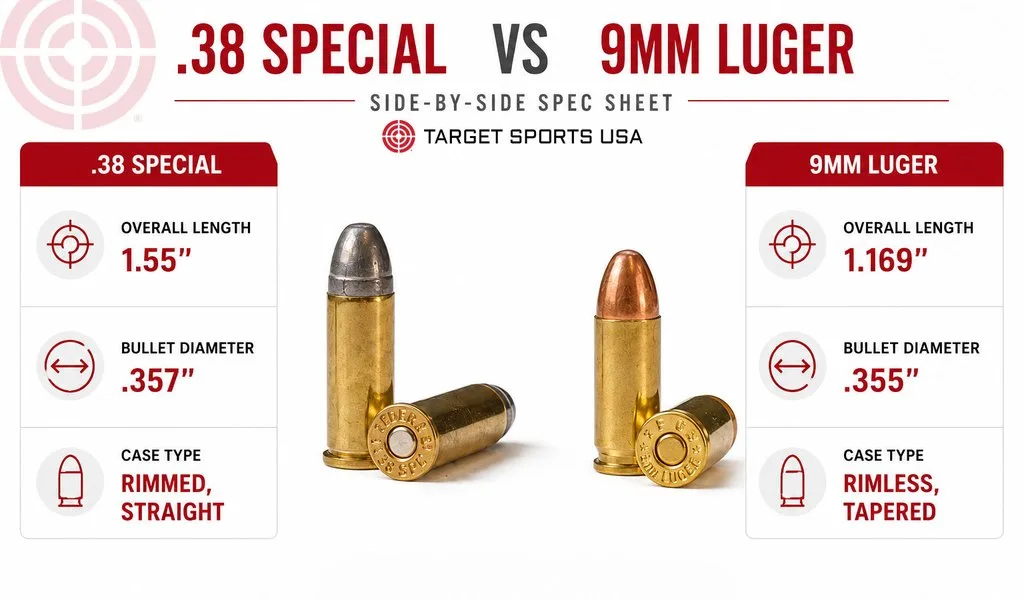
38 Special vs 9mm Specs, Side by Side
| Spec | .38 Special | 9mm Luger |
|---|---|---|
| Introduced | 1898 (Smith & Wesson) | 1901 (Georg Luger, DWM) |
| Parent Case | .38 Long Colt | 7.65x21mm Parabellum |
| Case Type | Rimmed, straight | Rimless, tapered |
| Bullet Diameter | .357” | .355” |
| Case Length | 1.155” | 0.754” |
| Overall Length | 1.55” | 1.169” |
| Common Bullet Weights | 110–158 grains | 115–147 grains |
| SAAMI Max Pressure | ~17,500 psi (+P: 20,000) | ~35,000 psi (+P: 38,500) |
| Typical Muzzle Velocity (factory) | 760–975 fps | 1,000–1,280 fps |
| Typical Muzzle Energy (factory) | ~173–274 ft lbs | ~323–418 ft lbs |
| Typical Platform | Revolver (5–6 rounds) | Semi-auto pistol (7–17+ rounds) |
| Typical Cost per Round | Higher | The cheapest centerfire pistol round there is |
| Practical Strong Suit | Revolver simplicity, soft shooting, 357 Mag upgrade path | Energy, capacity, price, availability |
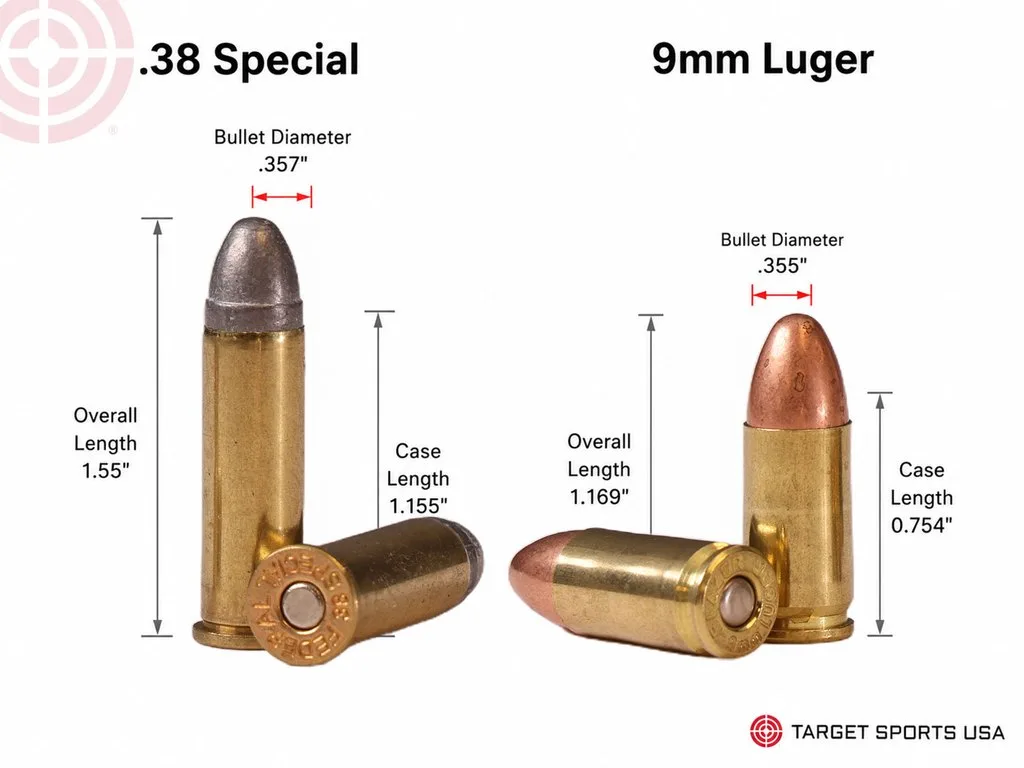
Look at those two pressure numbers, because they explain this entire comparison. The .38 Special is a black-powder-era case loaded to gentle pressures; the 9mm is a smaller, modern, high-pressure case. That’s why the physically bigger .38 cartridge is the less powerful one — and why the little 9mm gets more speed from less brass. Almost every other difference in this article flows downstream from that one fact.
One more wrinkle nobody puts in their spec table: the .38 Special’s bullet is actually wider than the 9mm’s (.357” vs .355”). “Thirty-eight” is a holdover from older naming conventions. The two calibers are near-twins in diameter — the fight is about velocity, capacity, and platform, not bullet width.
What Is the .38 Special? (And Why It Won’t Go Away)
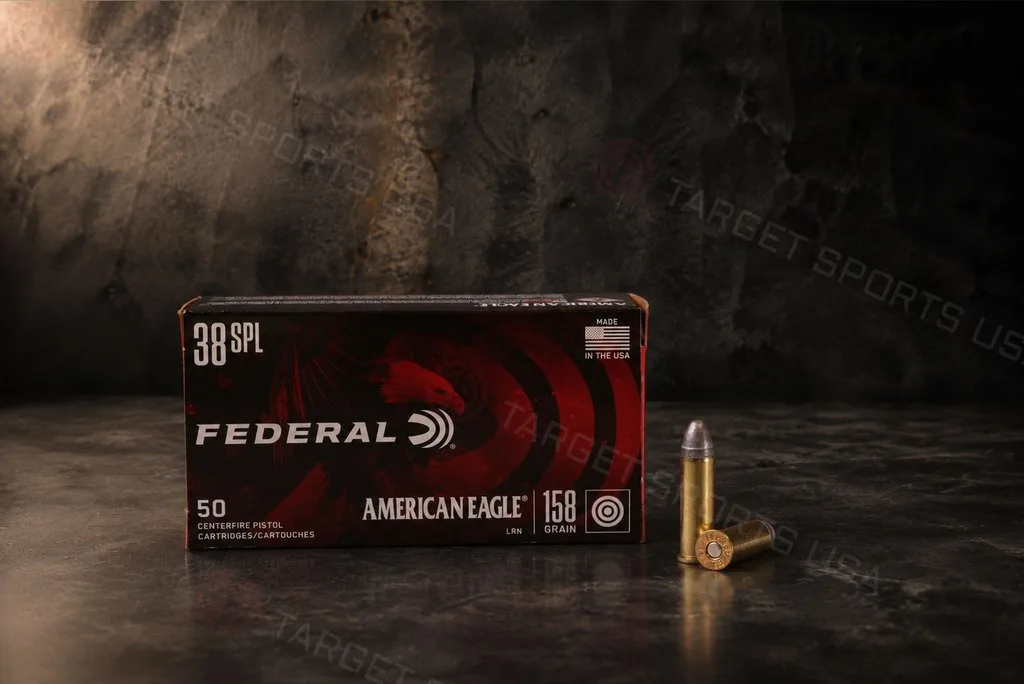
The .38 Special was introduced by Smith & Wesson in 1898 to fix the .38 Long Colt’s famously inadequate performance in the Philippines. It delivered a heavier bullet with a bigger powder charge, and it worked: the .38 Special became the American law enforcement cartridge from the 1920s clear into the 1980s, riding in the duty holsters of generations of cops and the nightstands of their neighbors.
When semi-autos took over police work, the .38 Special didn’t die — it downsized. Today it lives mostly in snub-nose revolvers: J-frames, Ruger LCRs, Taurus 856s — the simple, lumpy, point-and-pull guns that remain some of the best-selling concealed carry firearms in America. It also enjoys a quiet second life in lever-action carbines and Cowboy Action competition.
Two practical notes that matter for buyers. First, every .357 Magnum revolver also shoots .38 Special — cheaper, softer practice from the same gun (never the reverse; more on that in the FAQ). Second, .38 Special comes in standard-pressure and +P loadings, and the +P question is one of the most common things customers ask our desk — we’ll cover it below.
Browse all in-stock 38 Special ammo here.
What Is the 9mm Luger? (And How It Took the Crown)
Georg Luger developed the 9x19mm in 1901 by necking up his 7.65mm Parabellum case, and it spent most of the 20th century as the world’s military sidearm cartridge before conquering the American market in the “wonder nine” era. Today it is, without serious argument, the most popular handgun cartridge on earth: the standard for the U.S. military, the FBI, the overwhelming majority of police agencies, and the armed-citizen market.
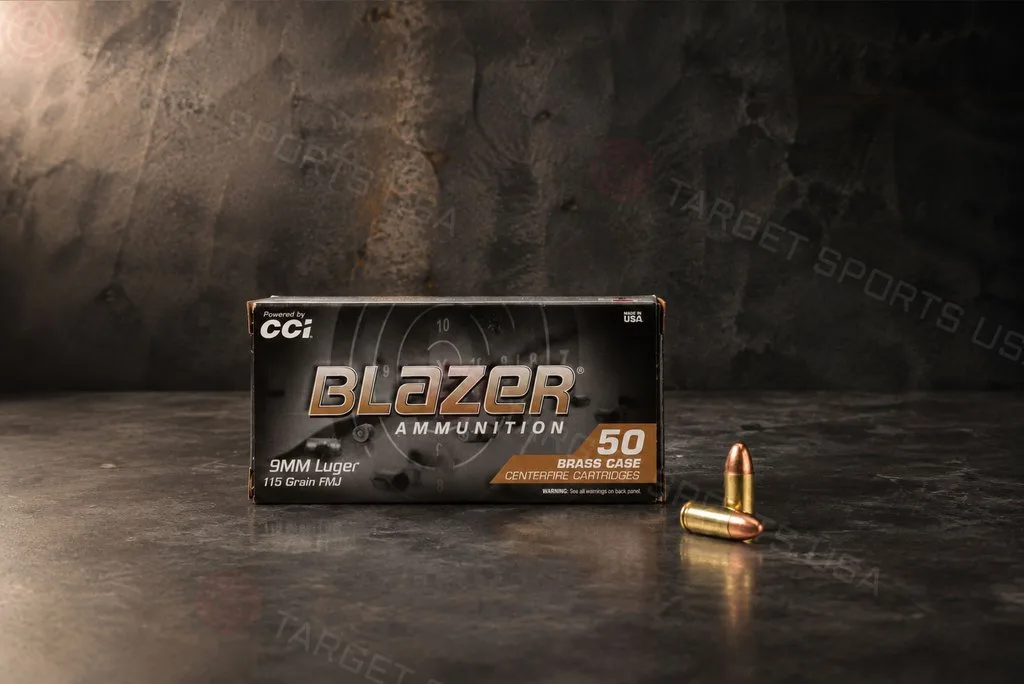
The reasons are boringly practical. Modern bullet design closed the old terminal-performance gap with bigger calibers, so agencies kept the caliber that was cheaper, softer-shooting, and held more rounds. A compact 9mm like a Glock 19 carries 15+1; a same-role .38 snub carries five. And economies of scale made 9mm the cheapest centerfire handgun ammo you can buy — which means more practice per dollar, which means more skill, which matters more than any caliber debate.
In our own review database, 9mm isn’t just the most popular handgun caliber — it’s the most-reviewed caliber we sell, in anything. Over 134,000 verified reviews and counting.
Browse all in-stock 9mm Luger ammo here.
38 Special vs 9mm Ballistics: Real Loads, Real Numbers
Here’s where most comparison articles hand you a chart of loads you can’t actually buy. Every load in this table is purchasable today, with its factory specs and its live customer rating next to it.
| Load | Caliber | Grain | Muzzle Velocity | Muzzle Energy | Verified Reviews | Avg Performance |
|---|---|---|---|---|---|---|
| New Republic Training and Range 158gr FMJ FP – RTR38SPCL | .38 Spl | 158 | 886 fps | 274 ft lbs | 833 | 4.75 / 5 |
| Federal American Eagle 130gr FMJ – AE38K | .38 Spl | 130 | 890 fps | 229 ft lbs | 445 | 4.81 / 5 |
| PMC Bronze 132gr FMJ – 38G | .38 Spl | 132 | 917 fps | 232 ft lbs | 264 | 4.80 / 5 |
| CCI Blazer Brass 125gr FMJ – 5204 | .38 Spl | 125 | 826 fps | 205 ft lbs | 425 | 4.78 / 5 |
| Federal American Eagle 158gr LRN – AE38B | .38 Spl | 158 | 760 fps | 203 ft lbs | 541 | 4.73 / 5 |
| Remington Golden Saber 125gr BJHP – GS38SBB | .38 Spl | 125 | 975 fps | 264 ft lbs | 137 | 4.78 / 5 |
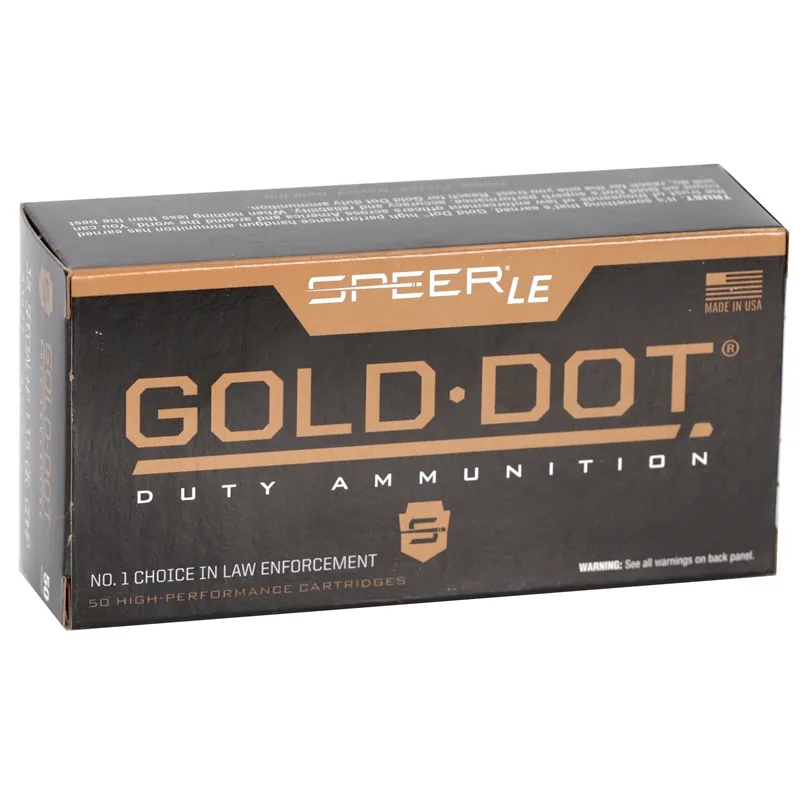
| Speer Gold Dot Short Barrel +P 135gr JHP – 53921 | .38 Spl +P | 135 | 860 fps | 222 ft lbs | 126 | 4.84 / 5 |
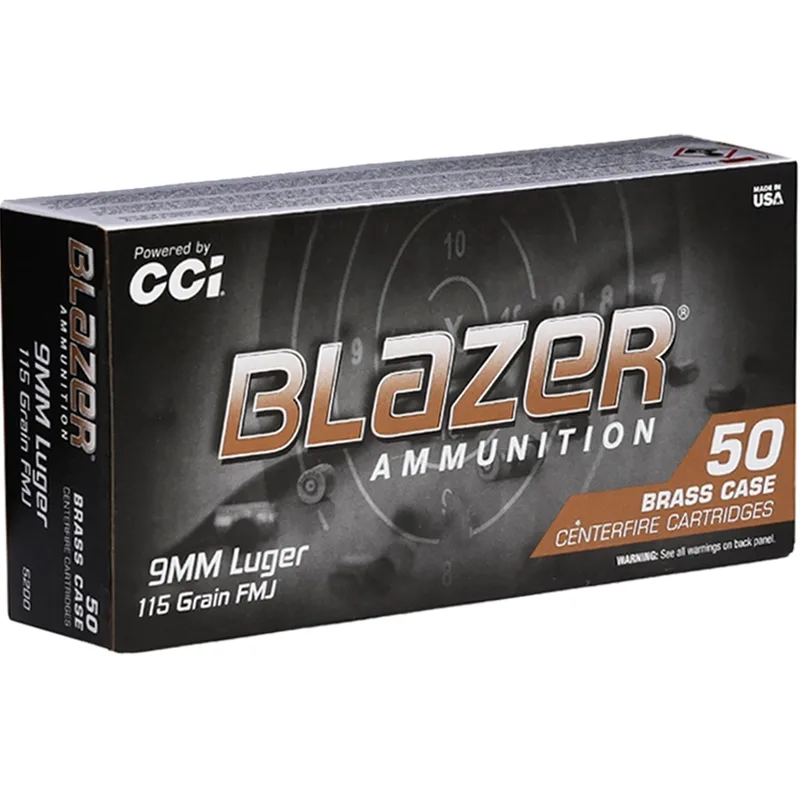
| CCI Blazer Brass 115gr FMJ – 5200 | 9mm | 115 | 1,125 fps | 323 ft lbs | 9,705 | 4.82 / 5 |
| Sellier & Bellot 115gr FMJ – SB9A | 9mm | 115 | 1,280 fps | 418 ft lbs | 2,920 | 4.84 / 5 |
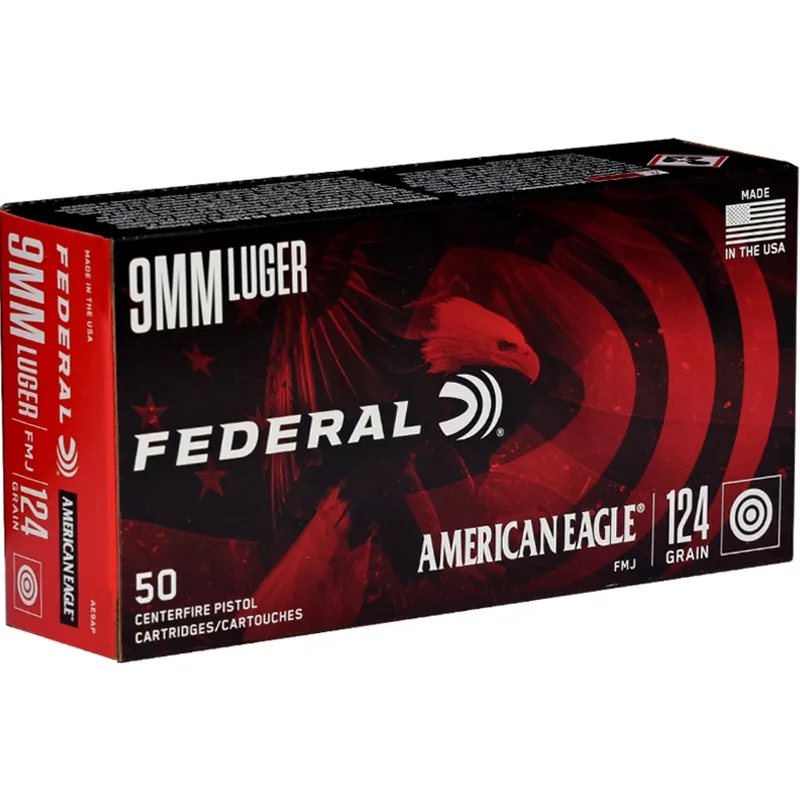
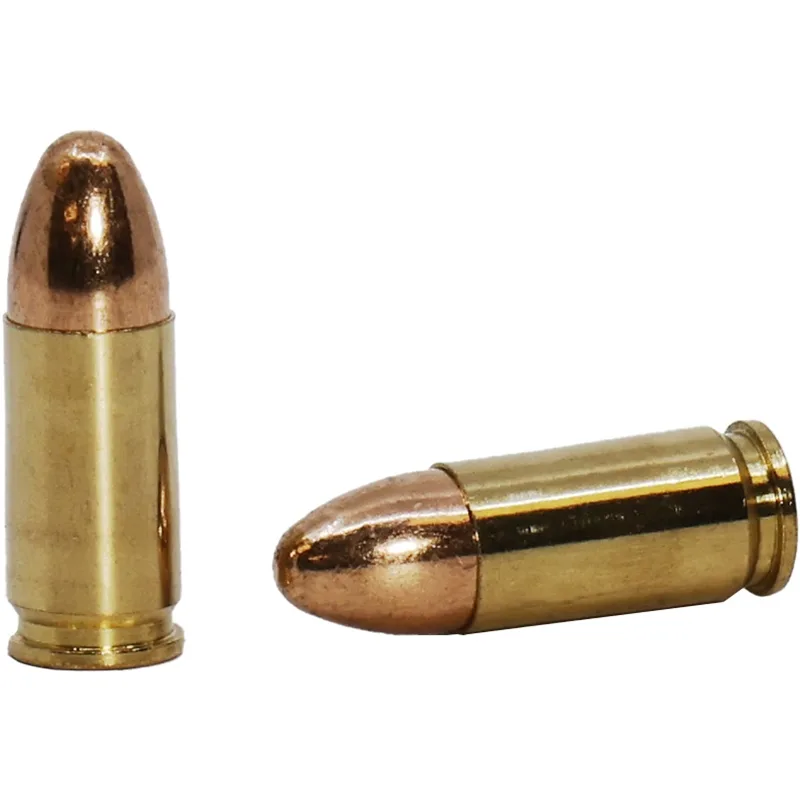
| Federal American Eagle 124gr FMJ – AE9AP | 9mm | 124 | 1,150 fps | 364 ft lbs | 3,180 | 4.84 / 5 |
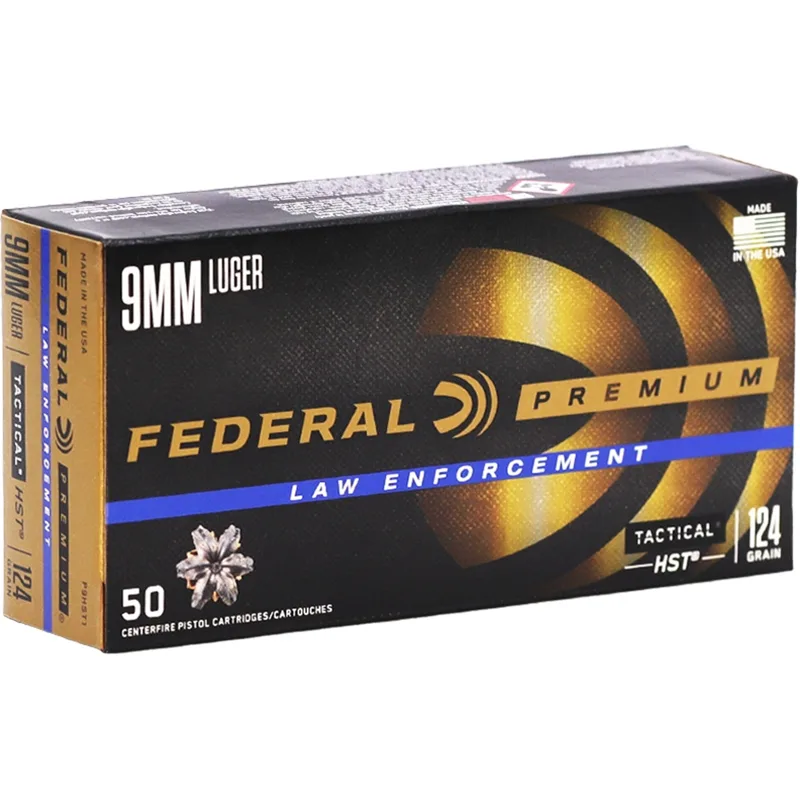
| Federal LE HST 124gr JHP – P9HST1 | 9mm | 124 | 1,150 fps | 365 ft lbs | 2,896 | 4.90 / 5 |
| Speer Gold Dot LE Duty 124gr JHP – 53618 | 9mm | 124 | 1,150 fps | 327 ft lbs | 1,226 | 4.92 / 5 |
| Federal HST LE 147gr JHP – P9HST2 | 9mm | 147 | 1,000 fps | 326 ft lbs | 2,285 | 4.92 / 5 |
Note: Velocity and energy figures are manufacturer specs from factory test barrels. Snub-nose revolvers (under 2”) and subcompact pistols will run meaningfully slower than book values — independent chronograph testing of short-barrel guns commonly shows .38 Special defensive loads in the 790–950 fps range and compact-pistol 9mm in the 1,000–1,100 fps range. Pressure-tested +P ammunition should only be used in firearms rated for it.
What jumps out of that table
- The energy gap is structural, not load-by-load. Our hottest standard-pressure .38 Special range load (274 ft lbs) makes less muzzle energy than our mildest featured 9mm (323 ft lbs). Across comparable loads, the 9mm carries roughly 50–150 ft lbs more energy — and that’s book spec against book spec, before barrel length enters the chat.
- Velocity is the whole story. .38 Special bullets are the same width and similar weights to 9mm bullets. They’re just slower — typically 760–975 fps versus 1,000–1,280 fps — because the .38 runs at half the chamber pressure.
- Velocity matters most for hollow points. Modern JHPs need speed to expand. This is why short-barrel .38 loads like Speer’s 135gr Gold Dot Short Barrel exist: they’re engineered to expand at snub-nose velocities. Generic .38 hollow points fired from a 1.7/8” barrel can fail to open up — independent gel testing across the industry shows exactly this pattern, which is also why some revolver shooters carry full wadcutters instead.
- Both calibers pass the bar that matters. Quality defensive loads in BOTH calibers meet FBI-standard penetration in ballistic gel from real carry guns. The 9mm does it with more margin and more expansion; the .38 does it adequately with the right ammunition. Nobody on the wrong end of either is going to feel undergunned by the math.
- Satisfaction doesn’t follow energy. Note the ratings column: the .38 loads average 4.7–4.8 stars, right alongside the 9mm. Slower doesn’t mean worse at the range — it means you must choose carry ammo more carefully.
The Recoil Question Everyone Gets Backwards
Ask the internet “which has less recoil, 38 special or 9mm?” and you’ll get confidently opposite answers. Here’s the trick: they’re both right, because they’re comparing different guns.
- In semi-auto pistols, the 9mm feels soft. The slide and recoil spring soak up a chunk of the impulse before it reaches your hand. A full-size 9mm is one of the easiest-shooting centerfire handguns there is — it’s a huge part of why the world standardized on it.
- In same-size revolvers, the .38 Special feels softer. Put a .38 Special and a 9mm through two identical steel snub revolvers and most shooters find the lower-pressure .38 the more pleasant of the two. A revolver has no slide — every bit of recoil comes straight back — and the 9mm’s higher pressure makes it the snappier round in a wheelgun.
- The worst recoil in this whole comparison belongs to neither cartridge generically — it’s hot +P .38 Special out of a sub-1-pound airweight snub. Featherweight gun, warm load, no recoil mechanism. Our customers who shoot the Gold Dot Short Barrel +P out of airweights call it “reasonable,” and it’s engineered to be — but generic +P out of an 11-ounce revolver is a hand-stinger, and you should know that before you buy one.
So the honest answer: a service-size 9mm pistol and a standard-pressure .38 in a steel revolver are both genuinely pleasant. The recoil problem isn’t the caliber — it’s putting either one in the smallest, lightest gun you can find. Buy the gun you’ll actually practice with.
135,000+ Verified Buyers Can’t All Be Wrong: The Review Data
Here’s the part nobody else ranking for this comparison can show you — aggregate stats from our verified customer review database (approved reviews only) across every .38 Special and 9mm Luger product we carry:
| .38 Special | 9mm Luger | |
|---|---|---|
| Verified customer reviews | 8,996 | 126,943 |
| Products reviewed | 165 | 556 |
| Average performance rating | 4.71 / 5 | 4.76 / 5 |
| Five-star performance ratings | 7,206 (80%) | 111,852 (83%) |
Honest takeaways from the data:
1. The popularity gap is a chasm — 15 to 1. For every .38 Special review in our database there are roughly fifteen 9mm reviews. That’s the availability argument in one number: more demand means more products (608 vs 165), more competition between manufacturers, and lower prices. The market voted, and it voted 9mm.
2. But satisfaction is nearly identical. 4.76 vs 4.71 across 135,939 combined reviews. .38 Special shooters are not settling — they’re just as happy with their ammo as the 9mm crowd. A five-point average gap across nine thousand reviews is statistical noise, not a verdict.
3. The .38 crowd is a revolver culture, and it shows. Read the .38 reviews and you meet LEOSA retirees re-qualifying with K-frames, grandfathers starting grandkids on wheelguns, and snub carriers matching practice ammo to their carry loads. The 9mm reviews are class-takers burning 1,000-round cases. Same hobby, different lifestyles — and the right caliber for you probably matches one of those pictures.
4. Defense loads are the highest-rated products on BOTH sides. Federal HST 147gr and Speer Gold Dot 124gr top the 9mm side at 4.92; Speer’s Gold Dot Short Barrel tops the .38 side at 4.84. When the stakes are highest, customers are pickiest — and these loads still deliver.
The Best 38 Special Ammo (As Reviewed by Real Shooters)
Each pick includes specs, the live review count and average performance rating, and real customer feedback quoted word-for-word — typos and all. Click any product name to view it on Target Sports USA.
New Republic Training and Range 38 Special 158 Grain FMJ FP – RTR38SPCL – Best Value 38 Special Range Ammo
| Manufacturer | New Republic |
| Caliber | 38 Special |
| Bullet Type | 158gr FMJ Flat Point |
| Muzzle Velocity | 886 fps |
| Muzzle Energy | 274 ft lbs |
| Grain | 158 |
| Packaging | Box of 50 / Case of 1000 |
| Verified Reviews | 833 |
| Avg Performance Rating | 4.75 / 5 |
Our most-reviewed .38 Special, and routinely the cheapest way to keep a wheelgun fed — with full 158gr bullets, not downloaded fluff:
“This has got to be the least expensive 38 special on the market and it is a 158 grain FMJ to top it off. Great loads for target, especially with the flat bullet shape. Seems to shoot pretty clean as well. Really no negatives to report.”
— Daniel S., verified buyer
“My snubby likes this ammo a lot. Shoots 2″ groups at 10 meter easily. As it is affordable, I get more reps with my gun which makes enjoy carrying it with confidence.” – Jan
— Arndt P., verified buyer
And because we print the bad with the good — here’s the other side:
“4 duds in 2 boxes/100 rounds is not acceptable. 2 different guns. Dirty as others have mentioned. I found their 9mm to be very good but the .38? Won’t buy it again.” – John D. (1 star)
That’s a real minority report (833 reviews still average 4.75), but budget ammo occasionally means budget primers. If a dud at the range is a dealbreaker for you, spend up for the Federal below — that’s exactly why we quote customers verbatim.
Check Prices on TARGET SPORTS USA
Federal American Eagle 38 Special 130 Grain FMJ – AE38K – Best Premium 38 Special Range Load
| Manufacturer | Federal |
| Caliber | 38 Special |
| Bullet Type | 130gr Full Metal Jacket |
| Muzzle Velocity | 890 fps |
| Muzzle Energy | 229 ft lbs |
| Grain | 130 |
| Packaging | Box of 50 / Case of 1000 |
| Verified Reviews | 445 |
| Avg Performance Rating | 4.81 / 5 |
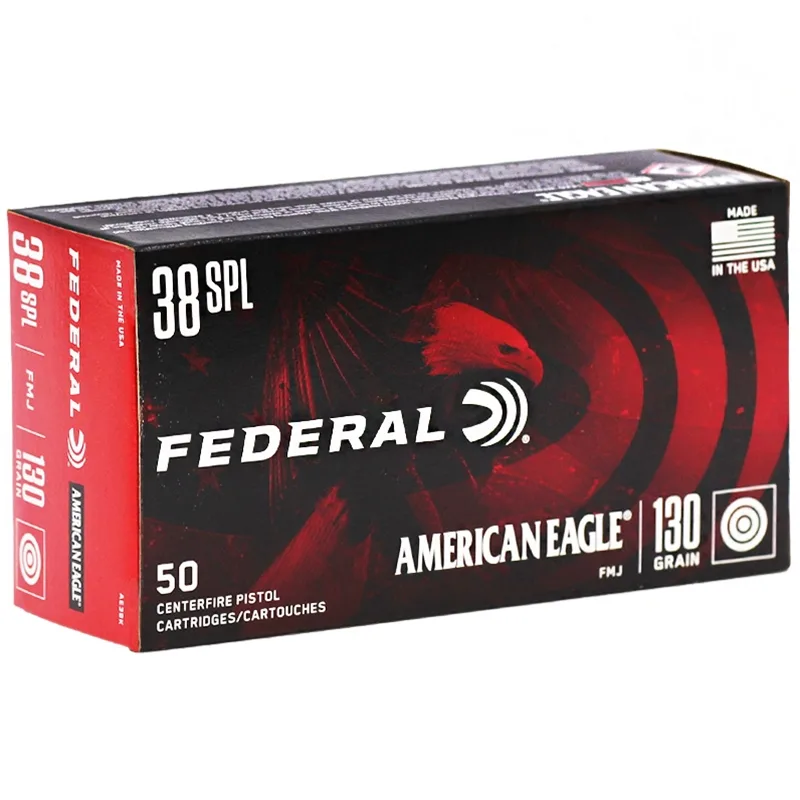
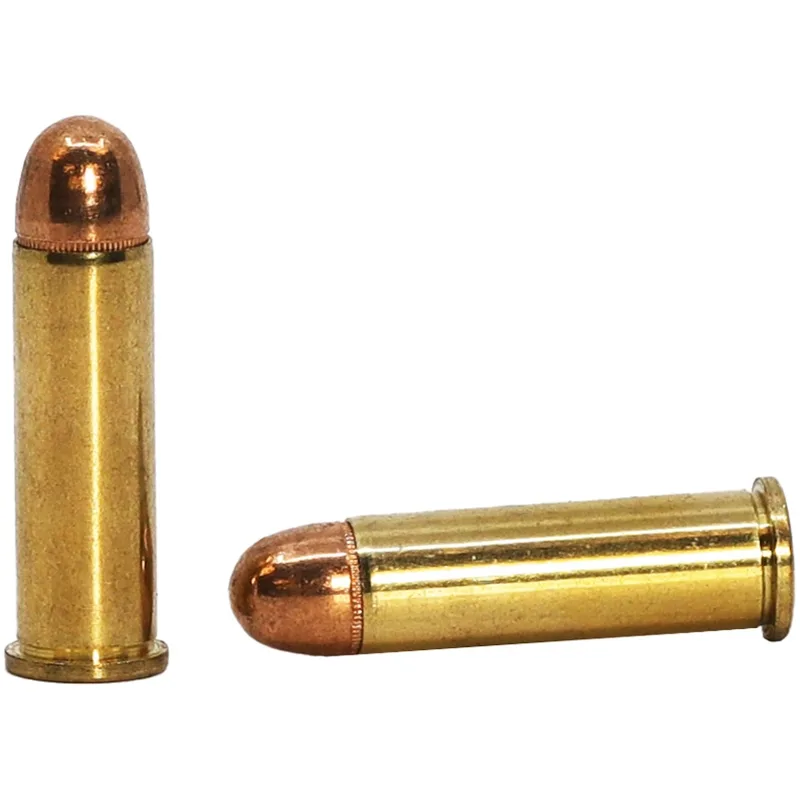
The highest-rated .38 range load we sell, and the one our revolver loyalists keep coming back to:
“Revolvers are known for reliability—you pull the trigger, they go boom. This Federal ammo is the perfect compliment for that because it is just as reliable, a good value, and is as consistent and accurate as most shooters will ever need.”
— Chris F., verified buyer
“Surprisingly more accurate out of my Smith and Wesson Model 10-14 when benched compared to PMC….I think the difference is enough to warrant the higher price. Once again, Federal proves itself superior to me.”
— Alex S., verified buyer
“Solid function from this .38 Special ammo made by Federal A&E, good clean burning, consistant accuracy, and overall good for anything from plinking on steel to accuracy on paper….use it in my EDC all the time”
— John I., verified buyer
Check Prices on TARGET SPORTS USA
CCI Blazer Brass 38 Special 125 Grain FMJ – 5204 – Best 38 Special for Qualifications & Training
| Manufacturer | CCI |
| Caliber | 38 Special |
| Bullet Type | 125gr Full Metal Jacket |
| Muzzle Velocity | 826 fps |
| Muzzle Energy | 205 ft lbs |
| Grain | 125 |
| Packaging | Box of 50 / Case of 1000 |
| Verified Reviews | 425 |
| Avg Performance Rating | 4.78 / 5 |
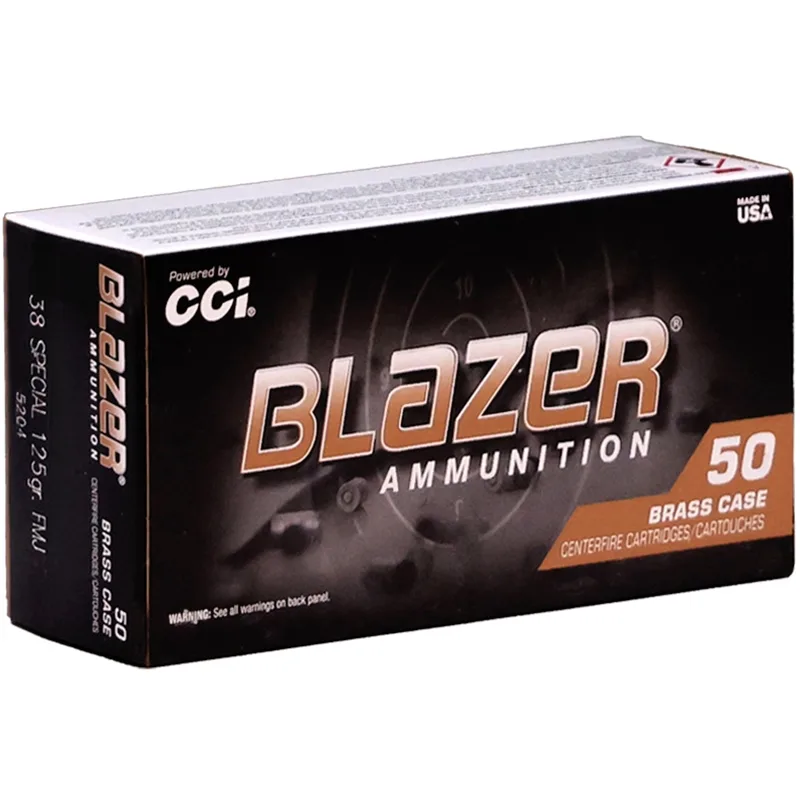
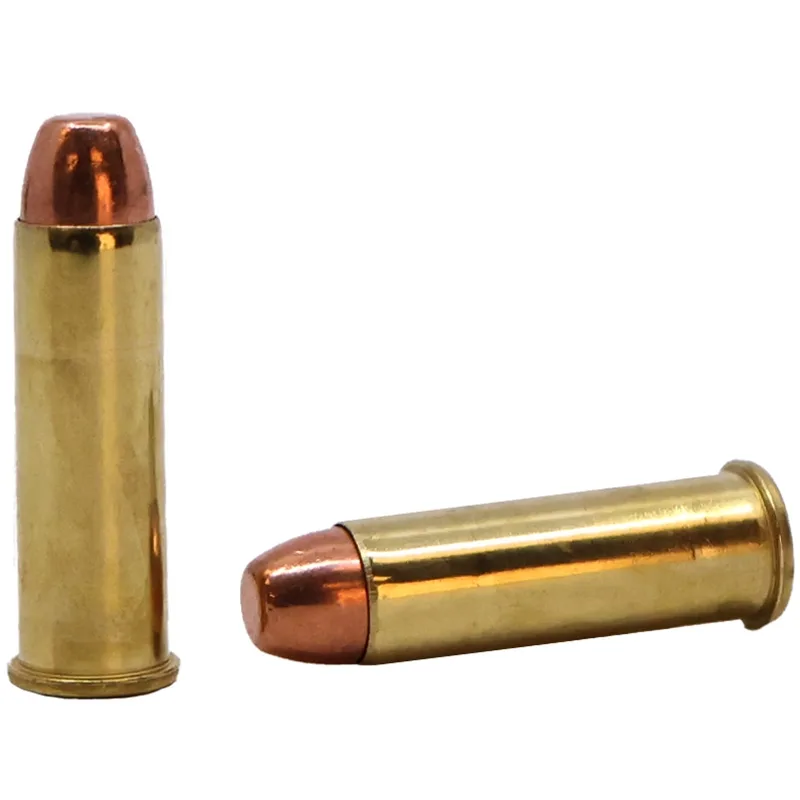
The same Blazer Brass our 9mm crowd buys by the ton, in wheelgun flavor — and a favorite of the re-qualification regulars:
“Good accuracy, consistent performance. Used it in my S&W M65, .357 for the revolver portion of my LEOSA Federal carry privileges re-qual, with no issues. Will buy again, when supplies return to normal.”
— Steve S., verified buyer
“Great ammo for the range. I used it for my yearly qualifying and it was perfect. The lighter bullet had less recoil so it was easier to stay on target after each shot.” – joseph b.
“Very clean and good curacy out of my 3″ Model 13 (K Frame Smith and Wesson.. I been using Target Sports for all of my ammo purchases lately and I am impressed.”
— MIchael S., verified buyer
When the people shooting for their carry credentials pick a load, that’s a quiet endorsement worth noticing.
Check Prices on TARGET SPORTS USA
Federal American Eagle 38 Special 158 Grain LRN – AE38B & Remington UMC 38 Special 130 Grain FMJ – L38S11 – The Classics
| Spec | AE38B | UMC L38S11 |
|---|---|---|
| Grain / Bullet | 158gr Lead Round Nose | 130gr FMJ |
| Muzzle Velocity | 760 fps | 790 fps |
| Muzzle Energy | 203 ft lbs | 173 ft lbs |
| Verified Reviews | 541 | 586 |
| Avg Performance Rating | 4.73 / 5 | 4.74 / 5 |
The 158gr lead round nose is the original .38 Special recipe — what the cartridge shot in 1898 and what lever-gun and classic-revolver shooters still feed it:
“This 38 Special was used in my Smith and Wesson 686-3 ,357 Magnum. The take down of steel plates was easy with this 158 Grain projectile. The bullets also left a tiny bit of residue, showing a nice clean burn with these Federal American Eagle rounds.”
— Jeremy C., verified buyer
“I purchased to use in both single action revolver and an 1873 lever action rifle. The bullets are too long to fit the required 10 rounds. Sometimes 9 usually only eight. Have to search for another brand.” – douglas g. (4 stars — lever-gun owners, check OAL fit)
And the Remington UMC is the new-shooter onboarding round, per the people doing the onboarding:
“I’ve shot around 700 rounds of this ammo. It has worked fine in both my Smith and Wesson model 10 and my Ruger GP100. Recoil is pretty low so it’s pleasant to shoot and good for new shooters.”
— Ed L., verified buyer
“My practice rounds in my snub revolvers. Close in weight and close in POI as my defense rounds. wish it would come down in price or it isn’t worth the minimal price difference compared to shooting exclusive 38+ SJHP”
— Andrew O., verified buyer
That second quote is the smartest cheap advice in this article: practice with ammo that matches the weight and point of impact of your carry load.
PMC Bronze 38 Special 132 Grain FMJ – 38G – Best 38 Special for New Revolver Shooters
| Manufacturer | PMC |
| Caliber | 38 Special |
| Bullet Type | 132gr Full Metal Jacket |
| Muzzle Velocity | 917 fps |
| Muzzle Energy | 232 ft lbs |
| Grain | 132 |
| Packaging | Box of 50 / Case of 1000 |
| Verified Reviews | 264 |
| Avg Performance Rating | 4.80 / 5 |
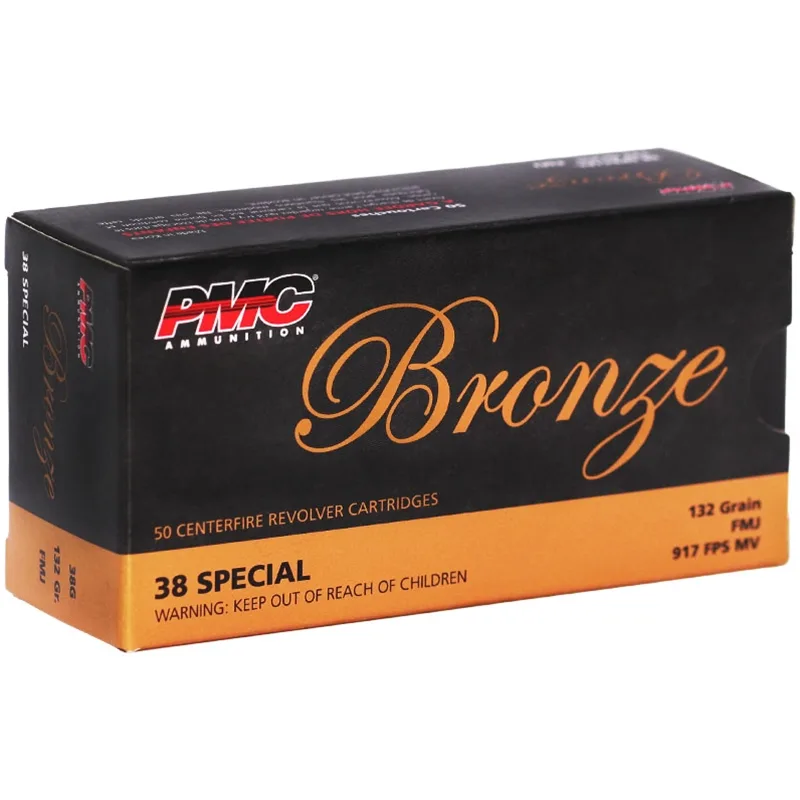
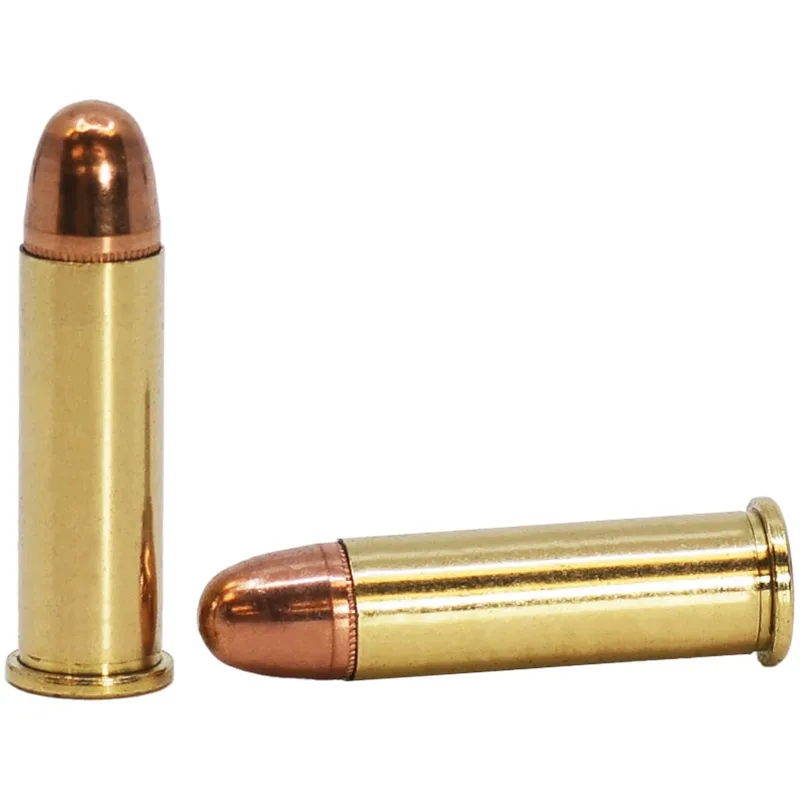
“reasonable priced practice 38 in today’s market. have always liked PMC quality. 50 rounds is a lot in a snub. had other brand of ammo with same paper spec but it felt weaker then PMC”
— Ross A., verified buyer
“Always had good luck with PMC ammo, thought I’d try these. Grandkids starting on revolvers. These are a step up power wise from my cast lead reloads. Shoot good. Clean.”
— Stephen P., verified buyer
“Had a few misfires on the first box that I shot. The primers were dented and went off after a second strike but makes me question quality control. I still have 4 more boxes to go through.” – Matthew T. (2 stars)
“50 rounds is a lot in a snub” might be the truest sentence in our entire review database. Budget your range trips accordingly.
Remington Golden Saber 38 Special 125 Grain BJHP – GS38SBB & Speer Gold Dot Short Barrel 38 Special +P 135 Grain JHP – 53921 – The Defense Pair
| Spec | Golden Saber GS38SBB | Gold Dot Short Barrel 53921 |
|---|---|---|
| Grain / Bullet | 125gr Brass JHP | 135gr JHP (+P) |
| Muzzle Velocity | 975 fps | 860 fps |
| Muzzle Energy | 264 ft lbs | 222 ft lbs |
| Pressure | Standard | +P (use only in +P-rated guns) |
| Verified Reviews | 137 | 126 |
| Avg Performance Rating | 4.78 / 5 | 4.84 / 5 |
The Golden Saber is the velocity champ of our .38 lineup and a service-revolver favorite:
“Excellent defensive rounds, especially for the price. Primarily intended for service size revolvers, however, these have proven to function quite well in ballistic gel even from snubby revolvers.”
— Igor B., verified buyer
“Remington Golden Saber ammo shoots well and comes out of the cylinder nicely. Carry this instead of .357 in my Sp101. Would definitely expect this to be enough in any standard defense situation.”
— Cody E., verified buyer
“Great round, powerful, moderately easy to control. Big flash though, but I carry this round in all my carry revolvers. Target Sports was the only online retailer that had this round in stock. Thanks”
— George M., verified buyer
And the Gold Dot Short Barrel is our highest-rated .38 Special, period — a bullet engineered to expand at snub velocities, which is exactly the .38’s weak spot:
“Goes where it’s aimed. 5/5 on a silhouette at 25 yards out of a Ruger LCR is possible, tight groups at 5, 7, and 10 yards. And I’m not very experienced. This is going to be my everyday ammo, range and CCW. Practice with what you carry.”
— Bruce R., verified buyer
“reasonable recoil / great accurate out of a S&W 637 airweight 5 rounds off hand double action at 10 yards all five will be in the 9 & 10 ring if I shoot single action off hand at 10 yards I can keep all 5 in the 10 ring”
— John W., verified buyer
“I use this ammo in a revolver that is a .357 and this is not as hard on this old hands as .357. The quality and performance is the best, I’m not looking for to much of a value when the ammo is in my EDC, I’m worth a lot .”
— Billy L., verified buyer
The Best 9mm Ammo (As Reviewed by Real Shooters)
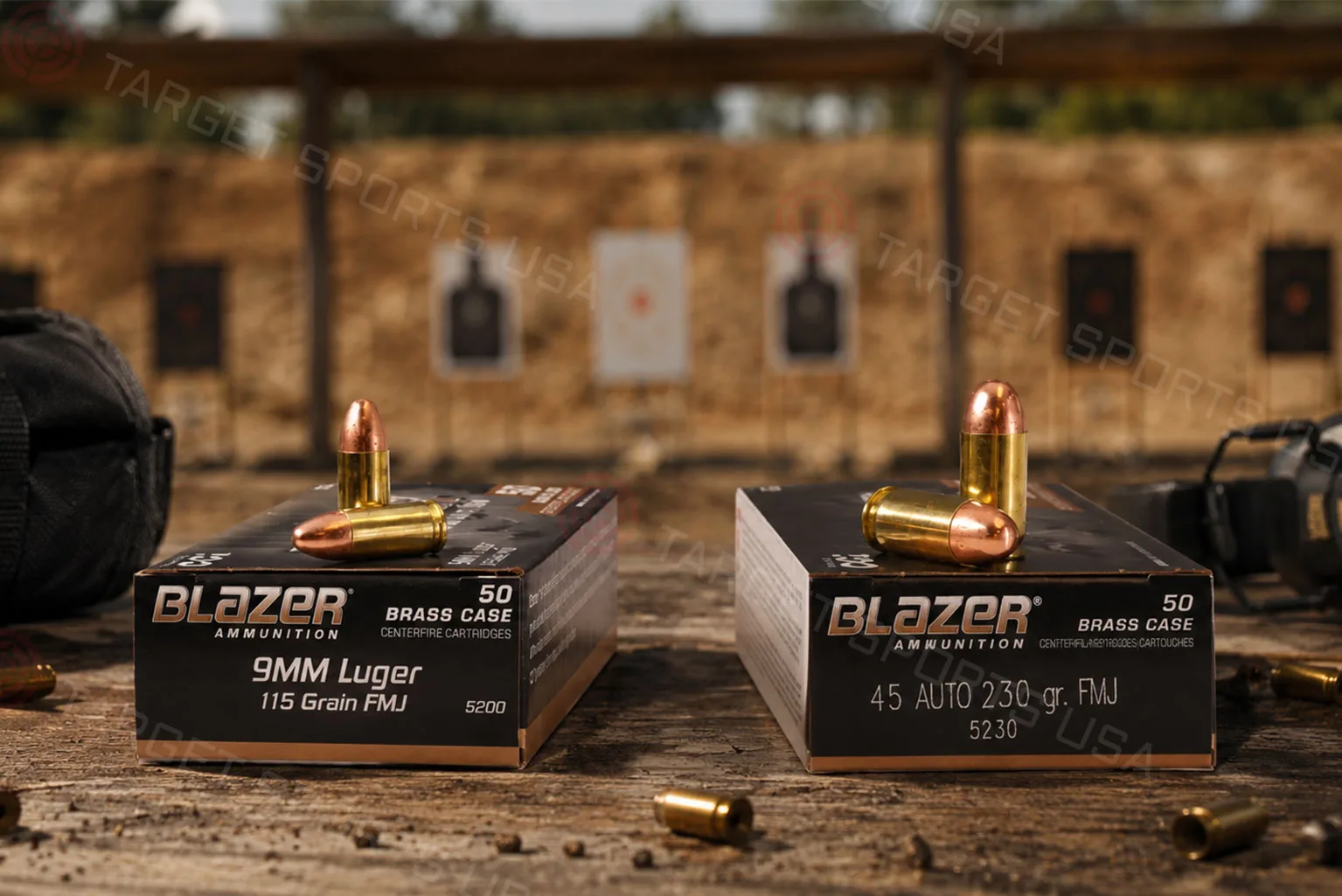
CCI Blazer Brass 9mm Luger 115 Grain FMJ – 5200 & 124 Grain FMJ – 5201 – The People’s Champ
| Spec | Blazer Brass 5200 | Blazer Brass 5201 |
|---|---|---|
| Grain / Bullet | 115gr FMJ | 124gr FMJ |
| Muzzle Velocity | 1,125 fps | 1,090 fps |
| Muzzle Energy | 323 ft lbs | 327 ft lbs |
| Packaging | Box of 50 / Case of 1000 | Box of 50 / Case of 1000 |
| Verified Reviews | 9,705 | 7,429 |
| Avg Performance Rating | 4.82 / 5 | 4.83 / 5 |
Seventeen thousand reviews between these two SKUs — nothing else in this article comes close. This is what America actually trains with:
“This 9mm ammo is really good for plinking. I use a Canik TP9 SA. I had no issues with the ammo. It fed reliably. Granted, it is a light load. It shoots soft, which is good because I took many first time shooters with this. They said that the recoil is mild.”
— Samuel L., verified buyer
“I purchased 1000 rounds of this for a class. At a time when some manufactures are letting quality control suffer to push out more rounds, I was one of the few on the line who didn’t have any ammo malfunctions. I’ll be getting more of this in the future.”
— Donald W., verified buyer
And here’s our favorite 9mm review in the database — because it’s from a revolver shooter:
“Velocity closely resembles my competition load. Went with this because it’s affordable and saves tons of time in the reloading room. Meets minimum power factor in my 929 for both ICORE and USPSA. No issue and primers ignite 100% on a light revolver action.”
— Leo K., verified buyer
Yes — 9mm revolvers are a whole competition discipline. The calibers cross over more than the internet arguments suggest. One honest counterpoint:
“Bought a case of this to restock and 2/3 of my pistols are having a hard time cycling it consistently. I’ve been running Blazer Brass through the same guns for years without a problem, not sure what has changed.” – Charles H. (2 stars)
A 4.82 average across 9,705 reviews means the misses are rare — but they exist, and we’d rather you read them here than find out alone.
Federal American Eagle 9mm Luger 124 Grain FMJ – AE9AP – Best Premium 9mm Range Load
| Manufacturer | Federal |
| Caliber | 9mm Luger |
| Bullet Type | 124gr Full Metal Jacket |
| Muzzle Velocity | 1,150 fps |
| Muzzle Energy | 364 ft lbs |
| Grain | 124 |
| Packaging | Box of 50 / Case of 1000 |
| Verified Reviews | 3,180 |
| Avg Performance Rating | 4.84 / 5 |
“One of the highest quality and affordable target loads. Put around 7-10k rounds of this over the years through hk, Glock, sig, walther, full size down to tiny micro 9’s and I’ve never had a malfunction or bad round that I can remember.”
— KEITH S., verified buyer
“My new go-to ammo. I like the 124grain FMJ because it pairs well with my Federal 124 grain defense ammo. It is a good idea to have your range ammo match your self defense ammo for consistency sake. This is hard to do with the other manufacturers.”
— Grant S., verified buyer
Notice that’s the same train-like-you-carry logic our .38 snub customers preach. Smart shooters think alike across calibers.
Check Prices on TARGET SPORTS USA
Sellier & Bellot 9mm Luger 115 Grain FMJ – SB9A – Best Full-Power 9mm Trainer
| Manufacturer | Sellier & Bellot |
| Caliber | 9mm Luger |
| Bullet Type | 115gr Full Metal Jacket |
| Muzzle Velocity | 1,280 fps |
| Muzzle Energy | 418 ft lbs |
| Grain | 115 |
| Packaging | Box of 50 / Case of 1000 |
| Verified Reviews | 2,920 |
| Avg Performance Rating | 4.84 / 5 |
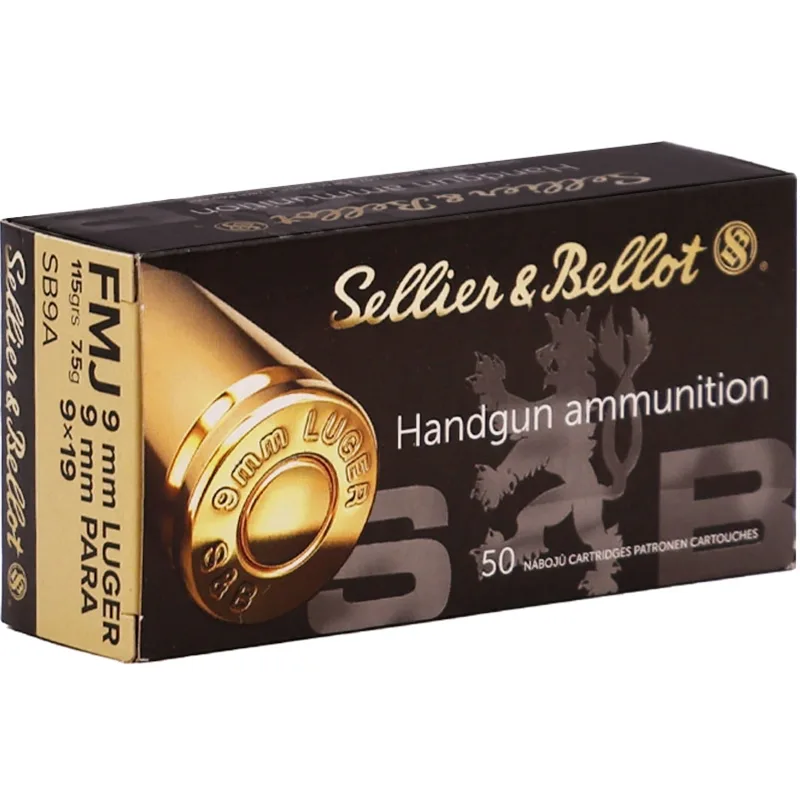
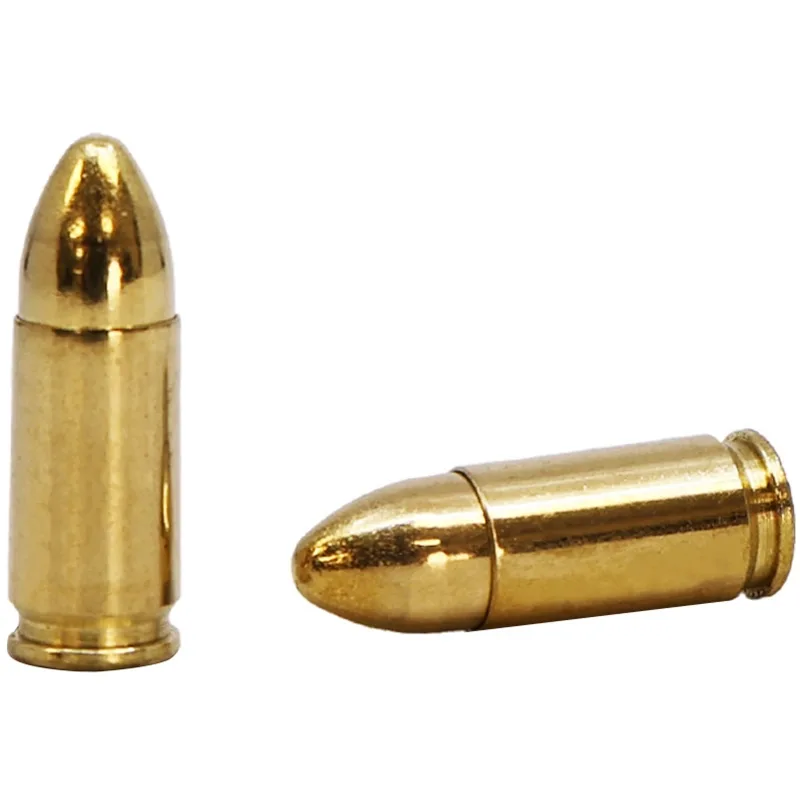
The hottest load in this entire article — 418 ft lbs of book energy, more than double our mildest .38 trainer. European-spec 9mm at its briskest:
“As a first time buyer of S&B they were very nice. Some might say it’s not important but the ammo was nice and polished and consistent. Packaging is small and can fit more if you’re storing a lot. No misfires and the recoil was more manageable than other 115gr.”
— Donald K., verified buyer
“These ran fine except when I tried to run them through my suppressor. I’ve run plenty of 115 grain ammo through it. In this case, the gun wouldn’t dependably cycle. Never had that problem with any other brand. Without a suppressor, it’s top notch.” – Michael S. (4 stars)
Check Prices on TARGET SPORTS USA
New Republic Training and Range 9mm 115 Grain FMJ – RTR9BR – Best Budget 9mm
| Manufacturer | New Republic |
| Caliber | 9mm Luger |
| Bullet Type | 115gr Full Metal Jacket |
| Muzzle Velocity | 1,180 fps |
| Muzzle Energy | 380 ft lbs |
| Grain | 115 |
| Verified Reviews | 3,699 |
| Avg Performance Rating | 4.75 / 5 |
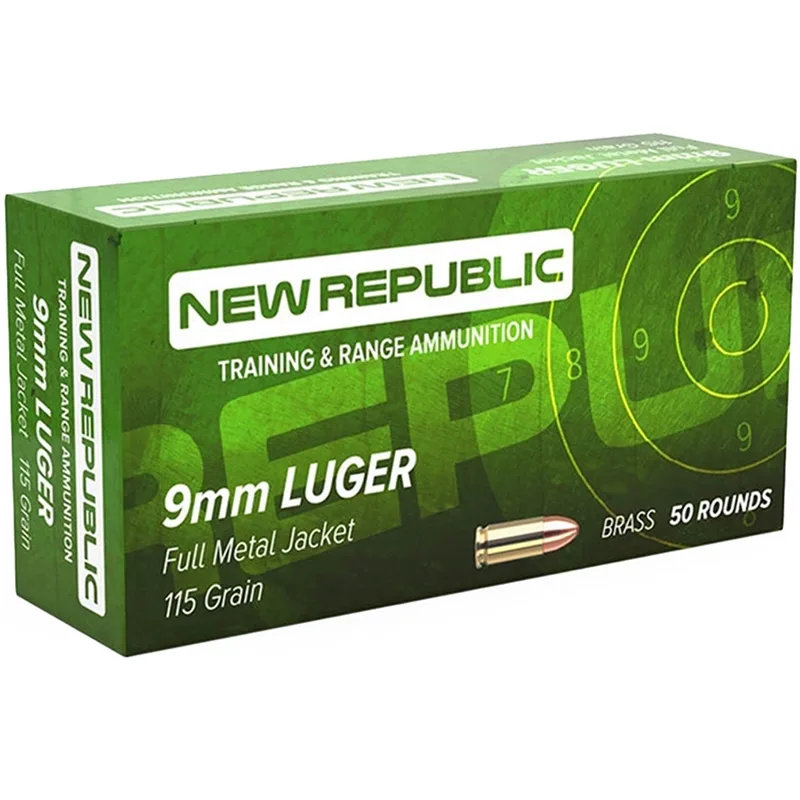
The price-floor pick, same as its .38 Special sibling above — and our customers grade it with the same honesty:
“Shot 2k rounds so far. Only had 1 light strike on a Glock which fired after a 2nd try, and found one other with a missing primer. No failure to feeds, no other malfunctions. A little dirty but not a big deal. Great value for range ammo in the current market.”
— Julian C., verified buyer
“Clean burning, feeds fine in all my 9mm pistols. Good accuracy (sub 1″ groups with my Masterpiece Arms DS9 IDPA match pistol w/ red dot sights at 7 yards, slow fire, indoor range without a rest). This will be my IDPA Match ammo for the year!”
— Wing C., verified buyer
“No bueno ammo… Did not want to feed and would jam with my Prodigy, Beretta and Canik TTI. As for my Glock 45 is worked well. I would never purchase this ammo again, I would rather spend a bit more and get quality ammo.” – Carlos A. (3 stars)
Budget ammo is gun-dependent — 3,699 reviews averaging 4.75 says most guns eat it happily, and Carlos says yours might not. Buy a box before you buy a case.
Check Prices on TARGET SPORTS USA
Federal Law Enforcement HST 9mm 124 Grain JHP – P9HST1 & 147 Grain JHP – P9HST2 – The Defense Standard
| Spec | HST 124gr P9HST1 | HST 147gr P9HST2 |
|---|---|---|
| Grain / Bullet | 124gr HST JHP | 147gr HST JHP |
| Muzzle Velocity | 1,150 fps | 1,000 fps |
| Muzzle Energy | 365 ft lbs | 326 ft lbs |
| Verified Reviews | 2,896 | 2,285 |
| Avg Performance Rating | 4.90 / 5 | 4.92 / 5 |
The carry-ammo benchmark, in the two weights the duty world argues about:
“This is EXCELLENT JHP ammunition. Cheap enough to practice with at the range, quality enough to use for self defense. And that’s the ideal – you want to practice with what you’re going to be defending your life with. DEFINITELY re-ordering some of this.”
— Bill K., verified buyer
“I usually favor the +p flavor of this ammo, but I enjoy the low recoil for my Glock 26 and shield pistols. 3 shot averages from different pistols: Shield 2.0: 1069 Glock 26: 1087 Glock 19: 1134 Glock 17: 1148 Glock 34: 1206 Sub 2000: 1357”
— Eric T., verified buyer
“I tested this ammo alongside other hollow points. I definitely like it. For a 147 grain, the recoil is mild and the ammo is very clean and clean burning. Praying I never have to use it. Shot out of my Beretta M92FS and KelTec Sub 2000. Shoots very well.”
— Samuel O., verified buyer
Yes, our customers publish their own six-gun chronograph tables in the review section. This is why we trust this data enough to build articles out of it.
Speer Gold Dot LE Duty 9mm 124 Grain JHP – 53618 – The Other Defense Standard
| Manufacturer | Speer |
| Caliber | 9mm Luger |
| Bullet Type | 124gr Gold Dot JHP |
| Muzzle Velocity | 1,150 fps |
| Muzzle Energy | 327 ft lbs |
| Grain | 124 |
| Packaging | Box of 50 / Case of 1000 |
| Verified Reviews | 1,226 |
| Avg Performance Rating | 4.92 / 5 |
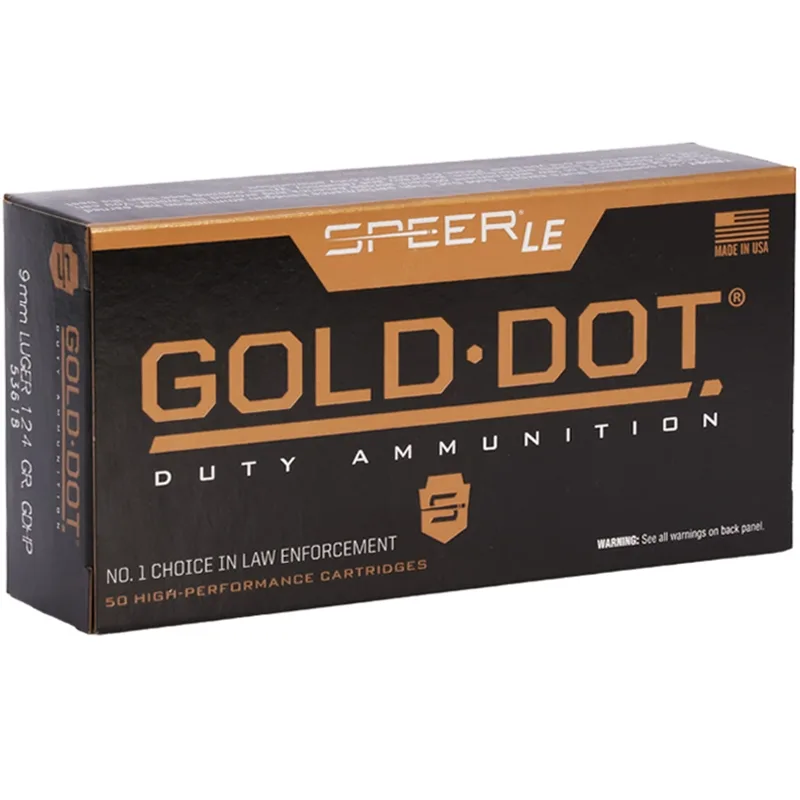
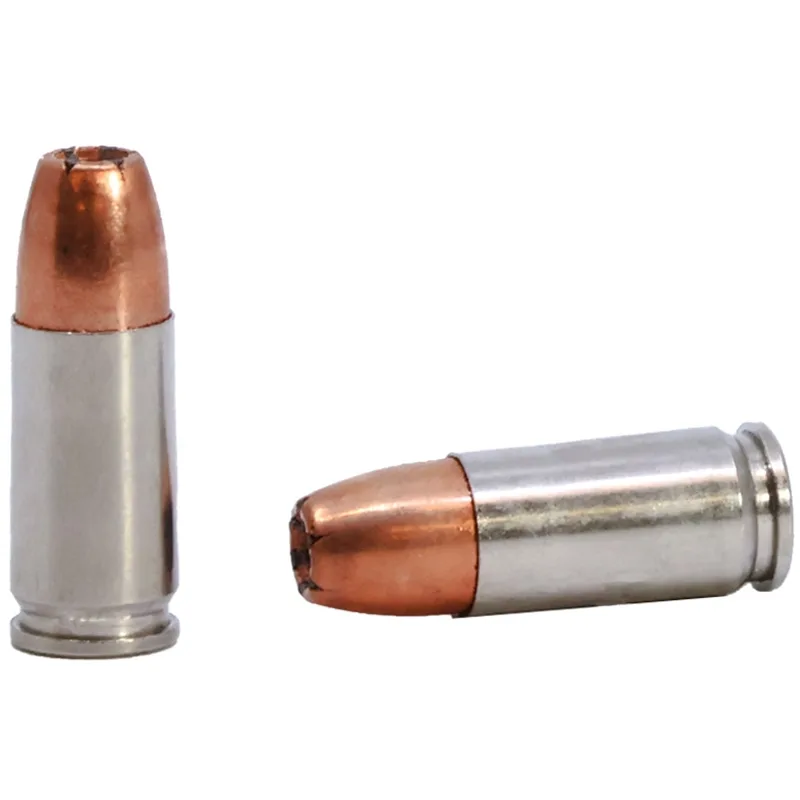
Tied for our highest-rated 9mm at 4.92 — and the direct big brother of the .38 Special Gold Dot Short Barrel above. Same bullet technology, both sides of this comparison:
“There are a lot of companies making very good quality defense ammo these days. But Speer Gold Dot and Federal HST are still the “Gold” standard. You simply can’t purchase defense ammo that is any better.”
— Charles V., verified buyer
“Would not buy again. Feed issues in Hellcat, PX4 Compact Carry, and Gen 1 Shield. I’ll stick to reputable brands from now on. Wasted my money on this. Made me think my Hellcat & PX4 where broken.” – Michael S. (2 stars)
That negative is one voice against 1,226 — but it’s the eternal carry-ammo rule in one review: vet your defensive ammo in YOUR gun before you carry it. Fifty flawless rounds minimum. That applies to revolvers too, where the failure mode isn’t feeding but bullets jumping crimp under recoil.
Check Prices on TARGET SPORTS USA
Capacity, Cost, and the Revolver vs Semi-Auto Question
The top-ranking articles treat this comparison as cartridge-versus-cartridge. Truthfully, it’s mostly a gun decision wearing a caliber costume. You can’t buy the .38 Special without (effectively) buying a revolver, and the 9mm’s biggest advantages only show up in a semi-auto.
Capacity: five versus fifteen
A typical .38 snub holds 5 rounds (some 6). A compact 9mm holds 10–15+1, and reloads come from quick, flat magazines instead of speedloaders or strips. There’s no spinning this: if round count and reload speed are high on your list, the 9mm semi-auto wins decisively. The revolver counterargument is about what happens before reloading matters — no slide to rack, no magazine to seat, no failure-to-feed drill, fires reliably from inside a coat pocket, and a trigger system simple enough to hand a non-enthusiast family member. Both arguments are correct. Pick the one that describes your life.
Cost: the 9mm’s compounding advantage
9mm is the cheapest centerfire pistol ammo made, full stop — the .38 Special typically runs meaningfully more per round for comparable range loads (industry retail comparisons commonly show .38 Special costing roughly half again more, sometimes nearly double). Our catalog depth tells the same story: 608 reviewed 9mm products versus 165 for .38 Special. Cheaper practice means more practice, and more practice beats every ballistic argument in this article. Compare live pricing yourself: 9mm Luger ammo | 38 Special ammo — and remember bulk case purchases ship free.
The sneaky third option: one gun that does both
Buy a .357 Magnum revolver and it shoots .38 Special all day — cheap-ish practice, magnum capability, one gun. Buy a 9mm revolver (Ruger LCR9, S&W 986, Taurus 905) and you get wheelgun simplicity with the cheapest ammo in the store — at the cost of dealing with moon clips. Several of our reviewers quoted above run exactly these setups. The calibers’ worlds overlap more than the comment sections admit.
How to Choose: Carry, Home Defense, New Shooters, Range Volume
Concealed carry: 9mm for most people — .38 snub for specific people
For the majority, a compact 9mm (with HST or Gold Dot in it) is the answer: triple the capacity, cheaper practice, softer in the hand than an airweight snub. But the .38 snub still earns its pocket for the person who carries deep-concealment, wants pocket-holster simplicity, or simply will not maintain a semi-auto. A revolver you actually carry beats a pistol you leave home.
Home defense: either — with the right ammo and the right user
Behind a nightstand door, capacity matters less and simplicity matters more. A 4” .357/.38 revolver loaded with Golden Sabers or Gold Dots is a superb home gun, especially for a household where not everyone is a shooter. A 9mm with a light and 15+1 of HST is equally superb for the practiced. Whatever you choose, load real defensive hollow points — one of our most-asked customer questions is whether range FMJ works for defense, and the honest answer is: that’s not what it’s for.
New shooters: the honest answer is “9mm pistol or .38 revolver — not the smallest version of either”
The data from our reviews is consistent: new shooters thrive with mild ammo in medium-size guns — a 115gr 9mm in a compact/full-size pistol, or a standard-pressure 130–132gr .38 in a steel K-frame-size revolver. What punishes beginners is the tiny-gun tax: airweight snubs and micro nines sting in any caliber. Multiple reviewers above bought their .38s specifically to start grandkids and spouses; multiple 9mm reviewers bought Blazer for first-timer range days. Both calibers are great teachers in the right-size classroom.
Range volume: 9mm, and it isn’t close
If your goal is hundreds of rounds a month, the 9mm’s price, selection (608 products!), and bulk availability make it the only sensible answer. “50 rounds is a lot in a snub,” as Ross A. testified. Our high-volume .38 shooters tend to be reloaders or people splitting time with a 9mm anyway.
Asked at the Ammo Counter: Real Customer Questions
We answer customer questions on product pages every day — 11,000+ published Q&As and counting. Real exchanges (lightly trimmed) that map straight onto this comparison:
Q: “Will this be OK to use in a standard 38 Special revolver? I ask because 357 Mag ammo should only be used in a revolver made for 357 Mag ammo.” A: This customer has the rule exactly right, and it’s worth engraving: .38 Special fires safely in any .357 Magnum revolver; .357 Magnum must NEVER be fired in a .38 Special gun. The .357 case is deliberately longer so it won’t chamber in most .38s — don’t test the exceptions. (The product he asked about was a .38 Special load, so he was good to go.)
Q: “What is the difference between CCI Blazer 38 Special 125 Grain +P Total Metal Jacket and Blazer 38 Special 125 GR. FMJ 5204?” A: Straight from our desk: the 3518 “is +P make sure your firearm is rated for +P, has a Total Metal Jacket bullet, and has an aluminum case. CCI Blazer Brass 38 Special Ammo 125 Grain Full Metal Jacket (5204) in NOT +P, is a Full Metal Jacket bullet, and has a brass case.” Typo ours, advice solid — +P only in +P-rated guns, always.
Q: “Is this good for self defense when one is concerned about over penetration?” (asked about a .38 target load) A: As we told Cindy: “No this is more of a target/practice ammo. You need Hollow Points for personal protection.” Range FMJ — in either caliber — is for practice. Carry purpose-built JHPs like the Gold Dots, Golden Sabers, and HSTs featured above.
Q: “Ok to use for Glock 19C with ported barrel?” (asked about Blazer Brass 9mm) A: “CCI recommends you do not use this product in a firearm with a ported barrel.” Compensated and ported guns can have ammo restrictions — check your manuals, plural.
Q: “What is the different between 115 grain and 124 grain?” A: As our desk put it: “the 124 Grain bullet will be a bit slower but will have a higher muzzle energy.” Heavier bullets also tend to shoot softer subjectively and hit slightly higher on the sights — which is why the 124gr/147gr weights dominate duty use while 115gr dominates the range.
Q: “The MPN # has GD at the end of it and the others are the same number without GD… muzzle velocity on this one is listed 945 and Energy is 248. I can’t find those numbers anywhere else the other 2 listing are MV 860 and ME 222, which matches Speer’s website.” A: A customer audit of our own spec listings on the .38 Gold Dot — and he was right that the 860 fps / 222 ft lbs figures match Speer’s published data, which is what we print in this article. When 143,000 reviewers and a live Q&A section proofread your spec tables, errors don’t survive long. That’s exactly why we trust this database enough to publish from it.
38 Special vs 9mm FAQ: Quick Answers to Common Questions
No. Despite the bigger case, the .38 Special operates at roughly half the chamber pressure of the 9mm, so factory .38 loads typically deliver 175–275 ft lbs of muzzle energy versus roughly 320–420 ft lbs for the 9mm. A hot +P .38 Special can approach a standard-pressure 9mm, but comparable load for comparable load, the 9mm is the more powerful cartridge.
No — they’re not interchangeable in any way. The bullets are nearly the same diameter (.357” vs .355”), but the .38 Special case is rimmed and much longer (1.155” vs 0.754”), runs far lower pressure, and headspaces differently. Never attempt to fire either cartridge in a gun chambered for the other.
No. The 9mm is a rimless, higher-pressure cartridge that will not headspace in a .38 Special cylinder and is not safe to fire in one. Dedicated 9mm revolvers exist (usually using moon clips), but they are chambered specifically for 9mm — a .38 Special or .357 Magnum revolver is not.
Yes — every .357 Magnum revolver safely fires .38 Special, and it’s the classic way to practice cheaply and softly with a magnum gun. The reverse is never true: .357 Magnum must not be fired in a .38 Special firearm. The longer magnum case is designed not to chamber in .38s for exactly this reason.
It depends on the gun. In semi-auto pistols, the 9mm feels mild because the slide absorbs part of the impulse. In identical revolvers, the lower-pressure .38 Special generally feels softer than 9mm. The harshest combination is +P .38 from a featherweight snub-nose; the gentlest is either caliber in a full-size gun.
Yes — with modern, purpose-built ammunition like the Speer Gold Dot Short Barrel 135gr +P or Remington Golden Saber 125gr, the .38 Special meets accepted penetration standards from real carry revolvers and has over a century of defensive record behind it. Its limits are capacity (usually 5 rounds) and the need to choose loads designed for short barrels.
Scale. The 9mm is the most-produced handgun cartridge on the planet, so manufacturing competition pushes prices to the floor — for comparable range loads, .38 Special commonly costs half again more per round. Our catalog reflects it: we stock and our customers review nearly four times as many 9mm products as .38 Special.
Either can be ideal — the size of the gun matters more than the type. A medium-frame .38 revolver offers unmatched simplicity (no slide, no magazines, simple manual of arms); a compact-to-full-size 9mm offers softer shooting, cheaper practice, and capacity. Avoid starting on ultralight snubs or micro pistols in any caliber, and feed beginners mild loads: 130–132gr standard-pressure .38s or 115gr 9mm range ammo.
The Last Word From the Counter
A hundred and forty-three thousand reviews later, here’s the honest scorecard. The 9mm is the better cartridge by nearly every measurable: energy, capacity, price, selection. That’s not opinion — our own shelves vote 608 products to 165. But our .38 Special customers rate their ammo within a rounding error of the 9mm crowd (4.71 vs 4.76), because the .38 was never trying to win a spreadsheet. It’s buying a different thing: the simplest, most forgiving defensive firearm ever made, with a cartridge that’s been ending fights since 1898 and a free upgrade path through every .357 Magnum ever built.
Our recommendation after 15+ years of selling both: if you’re optimizing, buy the 9mm. If you’re simplifying, buy the .38. And if you’re smart, eventually you’ll own both — half our .38 reviewers casually mention their 9mms in the same breath.
Shop the calibers: 9mm Luger Ammo | 38 Special Ammo | Bulk Ammo – Free Shipping

Jon-Paul (JP) is a seasoned firearms industry professional with over a decade of experience spanning firearms, sport shooting merchandising, and customer service. Passionate about all things 2A, he brings a wealth of hands-on knowledge to the world of firearms and ammunition.
When he’s not working, you’ll likely find JP at the range, diving into the latest ballistics trends, or engaging with the shooting community on forums like AR15.com
Feel free to connect with him to collaborate or chat about anything ammo-related.