Updated May 2026. Originally published February 27, 2023.
The detachable box magazine is easy to take for granted. It sits at the base of the grip or clips under the action, feeds rounds without ceremony, and gets swapped out when empty. Shooters who have handled one for years rarely think about where it came from, how it was designed, or why it holds the number of rounds it does.
Those questions have real answers. From inside one of the country’s largest online magazine retailers, what the current catalog shape tells you is that the modern standard capacities, whether 30 rounds for an AR-platform rifle or 15 to 17 rounds for a full-size service pistol, did not arrive by accident. They arrived through a specific sequence of military adoptions, design iterations, and one decade-long federal restriction that reshaped the commercial market on both sides of its expiration. That sequence is worth knowing.
Quick Take: There is no federal magazine capacity limit today. The 1994 federal 10-round limit expired in 2004, and capacity rules now exist only at the state level, where thresholds vary (commonly 10 or 15 rounds). The detachable box magazine traces to an 1879 patent, and the 30-round AR standard was set by the military before any of the regulation arrived.
What Is a Gun Magazine?
A firearm magazine is a storage and feeding device that routes cartridges into the action under spring tension. The spring-loaded follower pushes rounds upward, the bolt strips them from the feed lips, and the cycle continues until the magazine is empty or the shooter drops it.
The word itself traces to the Arabic “makhazin,” the plural of “makhzan,” meaning storehouse. It entered English in the 1580s as a military term for ammunition and powder depots, scaled down over centuries from warehouses to shipboard powder rooms, and by 1868, the Online Etymology Dictionary documents its use specifically for the “cartridge chamber in a repeating rifle.” The storehouse metaphor held.
Three broad magazine types define the category today. A fixed magazine is built into the firearm and loaded in place; the tubular magazines of lever-action rifles are the oldest common example. A detachable box magazine is the removable, spring-loaded device now standard on most semi-automatic rifles and pistols. A drum magazine stores rounds in a rotating cylinder arrangement, holding substantially more than a comparable box design at a cost in weight and profile.
Clip vs. Magazine: Why the Terms Get Confused
A clip holds cartridges together for the purpose of loading a magazine or firearm. A magazine is a spring-loaded storage device that feeds rounds directly into the action. The two are distinct components. Clips load magazines or firearms; magazines feed the action.
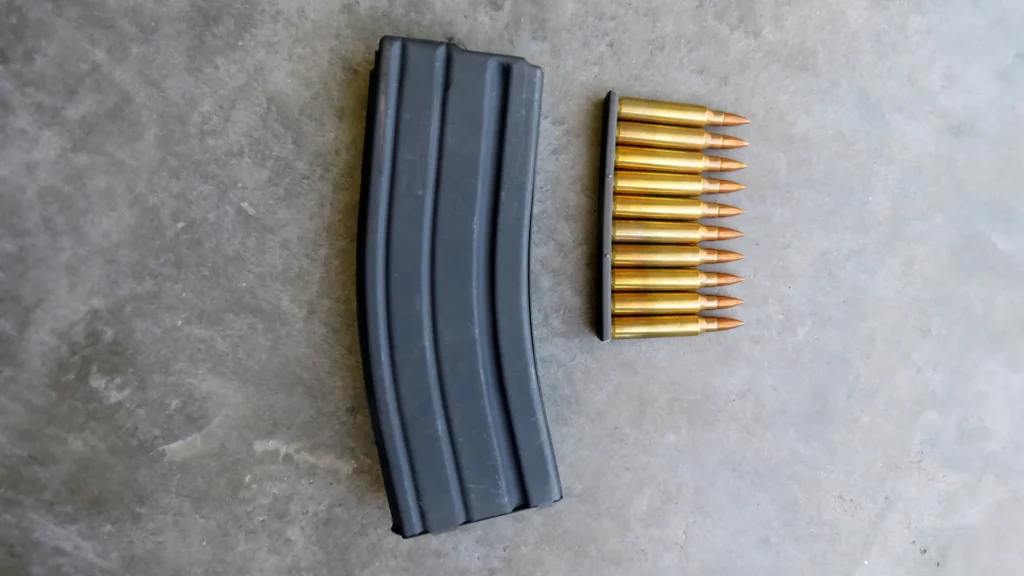
The confusion has a specific origin. The M1 Garand, the standard U.S. service rifle of World War II, used an eight-round en bloc clip. The clip and the cartridges were inserted into the fixed internal receiver together, and the empty clip ejected with the characteristic metallic sound on the final round. Because the Garand was the dominant American infantry rifle for nearly two decades, a generation of veterans applied the term “clip” to its loading device and by extension to similar devices across all firearms. The language blurred at exactly the moment when American familiarity with firearms was broadest.
Modern military, industry, and retail usage reserves “magazine” for the spring-loaded feeding device and “clip” for en bloc clips, stripper clips used in top-loading bolt-action designs, and moon clips used with revolvers. Common civilian usage still conflates the two. Neither is going away.
The name “magazine” also gets a question of its own. Why apply a word meaning “storehouse” to a firearm component? The answer is etymology doing exactly what it usually does: the storehouse metaphor traveled down the scale from military building to ship compartment to cartridge container, and the word arrived before anyone thought to rename it.
Early Magazines: Tube Feeds and Lever-Actions (1860s-1890s)
The first practical repeating firearms used tubular magazines. The Spencer repeating carbine (Model 1860), widely cited as adopted by the U.S. Navy and War Department around 1862-1863, stored seven rounds in a tube running through the buttstock. The Henry rifle (1860) carried 15 rounds in a tube below the barrel and saw Civil War use on both sides. Both designs shared one constraint: tube-feed geometry placed the nose of one round directly against the primer of the cartridge ahead of it. That contact made pointed, high-velocity bullets unsafe in a tube magazine. The geometry imposed a ceiling on ballistic performance that the box magazine would later remove.

James Paris Lee solved the fundamental problem. His U.S. Patent No. 221,328, granted November 4, 1879, introduced the vertical detachable box magazine. The design eliminated nose-to-primer contact, enabled rapid pre-loaded magazine swaps, and set the template for virtually every detachable box magazine that followed. Lee’s subsequent designs were adopted first as the Lee-Metford (British Army, 1888), then as the Magazine Lee-Enfield (1895), and as the Short Magazine Lee-Enfield (SMLE pattern, 1902-1903; the SMLE Mk III formally adopted January 26, 1907). The SMLE’s 10-round detachable box magazine became the defining proof-of-concept for the detachable magazine-fed infantry rifle.
The jump from tube to box is one of the more consequential engineering shifts in firearm history. It changed what was possible in a repeating arm, and the category has not looked back.
World War II and the Detachable Magazine Standard (1930s-1950s)

The Thompson submachine gun, marketed from 1921 in the M1921 configuration, used both stick magazines (20-round and 30-round box) and drum magazines (50-round and 100-round) in .45 ACP. Its receiver accepted both types interchangeably. The Thompson’s drum magazines were impractical for sustained military use, but its box magazine variants became the working standard for high-volume submachine gun fire.
The Browning Hi-Power Model 1935, finalized at Fabrique Nationale in Belgium, introduced the first widely adopted double-stack 9mm service pistol magazine at 13 rounds. That capacity was a significant step beyond the single-stack designs of the era, and the Hi-Power saw service on both Allied and Axis sides during the war.
The M1 Garand (U.S. Army adoption 1936) used the en bloc clip described above, not a detachable magazine. The M1 Carbine, adopted in 1941, was the clearer counterexample: it used a detachable 15-round box magazine from the outset, with a 30-round curved detachable magazine introduced during the war, particularly for the select-fire M2 variant. The M1 Carbine 30-round magazine is worth noting: it established the concept of a 30-round detachable box magazine in U.S. service well before the AR-15 platform made that number synonymous with the modern sporting rifle.
The AR-15 and the Rise of the 30-Round Standard (1960s-1990s)

The M16 was type-classified and adopted by the U.S. Army in 1964, initially issued with 20-round steel and aluminum magazines. Combat experience in Vietnam generated direct troop feedback for greater capacity. By 1968, Army researchers formally recommended 30-round magazines, and Colt began manufacturing them around the same year, with early distribution to Special Forces units.
The 20-round magazine remained standard through most of the Vietnam era while 30-round production and design refinement proceeded through the 1970s. NATO adopted STANAG 4179 in October 1980, standardizing the 30-round magazine as the primary interface capacity for 5.56 NATO rifles across the alliance. By the early 1980s, improved 30-round aluminum magazines had become the effective U.S. service standard for M16A1/A2 platforms. Operation Urgent Fury (Grenada, 1983) is widely cited in trade references as the first conflict where 30-round magazines were broadly visible in use by U.S. forces.
The pistol side of the capacity story was moving in parallel. The Beretta 92 (designed approximately 1972, adopted by the U.S. military as the M9 in 1985) used a 15-round double-stack 9mm magazine. The SIG P226, developed around 1980-1983 and launched commercially in 1984, also used a 15-round double-stack 9mm configuration. The Glock 17 (designed 1981-1982, adopted by the Austrian military in 1983, entering U.S. commercial channels in the mid-1980s) combined a polymer frame with a 17-round double-stack magazine. Its rapid adoption across U.S. law enforcement agencies drove mass-market uptake of the double-stack pistol format. By the 2000s, the double-stack magazine was effectively the default for full-size service pistols across the industry.
This is the context that matters for the decade that followed. The 30-round AR-pattern magazine and the 15-to-17-round double-stack pistol magazine were both commercially and militarily standard before the 1994 federal legislation addressed them. The caliber reference for common AR-platform and pistol cartridges covers the full breakdown of what those platforms were chambered for.
The 1994 Federal Magazine Capacity Limit and Its Sunset
On September 13, 1994, the Violent Crime Control and Law Enforcement Act of 1994 was signed into law as Public Law 103-322. The magazine capacity provisions were codified at 18 U.S.C. § 922(w). The statute’s definition of a restricted device, codified at 18 U.S.C. § 921(a)(31) as enacted, read: “a magazine, belt, drum, feed strip, or similar device manufactured after the date of the enactment of this subsection that has a capacity of, or that can be readily restored or converted to accept, more than 10 rounds of ammunition.”
The law prohibited the manufacture for sale, transfer, and import of newly produced magazines with a capacity exceeding 10 rounds. It did not apply retroactively to magazines manufactured before the enactment date. The grandfather clause at 18 U.S.C. § 922(w)(2) preserved the legality of possessing pre-ban magazines, which were manufactured, traded, and sold throughout the restriction period at a premium.
The 10-year sunset provision was built into the statute. The ATF’s open letter on the expiration stated precisely: “effective 12:01 a.m. on September 13, 2004, the provisions of the law will cease to apply.” The signing date and the sunset date were exactly ten years apart.
What happened after midnight on September 13, 2004 was straightforward: manufacturers resumed production of previously restricted configurations. The commercial response was immediate and substantial. Magpul introduced the PMAG 30 commercially in 2007, a fully polymer 30-round AR-15/M16 magazine with an anti-tilt follower that became the dominant commercial polymer magazine of the post-ban era. U.S. troops during subsequent deployments regularly purchased PMAGs personally, which is a reasonable measure of how far the commercial and military trajectories had converged.

The 10-year federal restriction is the regulatory predecessor to the state-level capacity laws that followed. Several states enacted or maintained their own restrictions when the federal law was in effect; others passed new restrictions after the federal sunset. The regulatory chapter of magazine history did not close in 2004; it moved to the states.
Modern Magazine Design: Polymers, High-Capacity, and the Aftermarket (2004-Present)
Post-2004 magazine design evolved on multiple tracks. The polymer box magazine, led by Magpul’s PMAG line, displaced aluminum as the preferred material for AR-platform magazines across both commercial and military supply chains. Magpul’s PMAG line iterated through Gen 2 (M2) and Gen M3 designs, each addressing follower geometry, impact resistance, and compatibility across different rifle platforms.
Extended-capacity drum designs found a durable aftermarket. The Beta C-Mag, whose design received a patent in 1987 with that year commonly cited as its commercial introduction, stores 100 rounds in a twin-drum arrangement and had a long history of military and law enforcement evaluation. SureFire revealed its MAG5-60 (60-round) and MAG5-100 (100-round) magazines in December 2010, showing them at the SHOT Show in January 2011 with a stated ship date of March 2011. Magpul introduced the D-60, a 60-round 5.56 drum, in 2015.
The terminology question that runs through all of this is worth addressing directly, because it affects how you read coverage of the category. “High-capacity magazine” originates in U.S. policy and advocacy discourse, cemented by the 1994 federal threshold. Advocacy organizations use the term to describe any magazine holding more than 10 rounds, emphasizing a lethality argument. Regulators and legislators more commonly use “large-capacity magazine” in statutory language, with thresholds that vary by jurisdiction. Gun-rights groups and most firearms retailers use “standard-capacity magazine” to describe the factory-shipped magazine for a given firearm, arguing that a 30-round AR-pattern magazine or a 15-to-17-round service pistol magazine represents the original normal configuration.
Both terms are in common use. Neither is technically neutral; each reflects a distinct framework for what counts as “normal.” This piece uses neither as an editorial descriptor.
State-Level Magazine Capacity Laws: The Current Landscape
The 1994 federal restriction gave way to a patchwork of state-level laws that continues to evolve. As of the research date for this piece (May 2026), the following states and jurisdictions maintain statewide magazine capacity restrictions:
California (10 rounds), Colorado (15 rounds), Connecticut (10 rounds), the District of Columbia (10 rounds), Hawaii (10 rounds, with scope that varies by firearm type), Illinois (magazine capacity restrictions in effect; verify current thresholds against Illinois statute before purchase), Maryland (10 rounds), Massachusetts (10 rounds), New Jersey (10 rounds), New York (10 rounds), Oregon (10 rounds), Rhode Island (10 rounds), Vermont (10 rounds), and Washington (10 rounds).
Virginia’s new magazine capacity rule, signed in May 2026 and effective July 1, 2026, sets a 15-round threshold (more than 15 rounds becomes the prohibited configuration under the new law). It is the most recent addition to this list. For a detailed breakdown of what Virginia’s rule covers, what it exempts, and what remains available to Virginia residents, Virginia’s new magazine capacity rule explained covers it in full.
Washington state’s 10-round restriction is covered in detail in Washington state’s 10-round magazine capacity rule, which provides useful context for how state-level enforcement and compliance work in practice.
Before you buy: State laws change, and this list reflects a single research date. Check your local laws before purchasing or transporting magazines of any capacity. Rules governing sale, acquisition, and possession vary significantly from state to state, and several states have specific provisions around grandfathered magazines and the distinction between possession and transfer.
The commercial market supplies compliant configurations across all common state thresholds; magazine options across capacity levels span the full range of current state restrictions.
Timeline: Key Dates in Magazine History
| Year | Development | Significance |
|---|---|---|
| 1860 | Spencer carbine tubular buttstock magazine; Henry rifle 15-round tube | First practical repeating firearms; tube-feed geometry limits pointed-bullet use |
| 1862-1863 | Spencer adopted by U.S. Navy and War Department | First widespread U.S. military repeating rifle use |
| 1868 | “Magazine” first documented for “cartridge chamber in a repeating rifle” | Language catches up to the technology |
| 1879, Nov. 4 | James Paris Lee patents the vertical detachable box magazine (U.S. Patent No. 221,328) | The design template for virtually every modern detachable magazine |
| 1888 | Lee-Metford adopted by British Army | First major military adoption of the detachable box magazine |
| 1895 | Magazine Lee-Enfield (MLE) adopted | Refinement of Lee’s system; 10-round capacity |
| 1902-1903 | SMLE pattern adopted; Mk III formally adopted January 26, 1907 | Definitive bolt-action magazine-fed infantry rifle |
| 1921 | Thompson M1921 marketed; stick and drum magazines in .45 ACP | Submachine gun era demonstrates interchangeable magazine formats |
| 1935 | Browning Hi-Power Model 1935; 13-round double-stack 9mm | First widely adopted double-stack pistol magazine |
| 1936 | M1 Garand adopted; 8-round en bloc clip | Biggest source of “clip vs. magazine” terminology blur |
| 1941 | M1 Carbine adopted; 15-round detachable magazine; 30-round variant follows | First 30-round detachable box magazine in U.S. service |
| 1964 | M16 adopted with 20-round aluminum magazine | Baseline for modern AR-platform magazine history |
| 1968 | U.S. Army recommends 30-round magazines; Colt begins production | The 30-round standard begins |
| 1980, Oct. | NATO STANAG 4179 adopted; 30-round primary capacity | 30-round becomes an alliance standard |
| 1983 | Early 1980s: 30-round aluminum is effective U.S. military standard | Grenada operation marks broad operational use |
| 1983-1985 | Glock 17 in Austrian service (1983); SIG P226 commercial launch (1984); Beretta M9 adopted (1985) | Double-stack 9mm becomes NATO pistol standard |
| 1987 | Beta C-Mag patent; widely cited as commercial introduction | First modern 100-round twin-drum design |
| 1994, Sept. 13 | Violent Crime Control and Law Enforcement Act signed; 10-round federal magazine limit (Pub. L. 103-322) | Decade-long restriction on new magazine production over 10 rounds |
| 2004, Sept. 13 | Federal AWB provisions expire at 12:01 a.m. | Immediate commercial expansion; restricted configurations resume production |
| 2007 | Magpul PMAG 30 introduced commercially | Polymer magazine becomes the market standard |
| 2010, Dec. | SureFire MAG5-60 and MAG5-100 revealed | Extended-capacity drum magazines enter the commercial mainstream |
| 2015 | Magpul D-60 (60-round drum) introduced | Drum format reaches the mass commercial market |
| 2026, May 14 | Virginia signs new magazine capacity rule; effective July 1, 2026 | Most recent state-level threshold change; 15-round limit |
Where the Category Stands
The magazine category today is a product of that full arc: a design lineage running from James Paris Lee’s 1879 patent through a decade of federal restriction, a post-2004 commercial expansion, and an ongoing state-by-state regulatory variance that requires any serious shooter to know their jurisdiction.
What the current SKU mix reflects, from a retailer’s vantage, is that the market has settled into several defined segments. Compliant configurations for restricted states, standard-configuration products for unrestricted jurisdictions, and extended-capacity options that exist in specific commercial and sporting contexts. None of that segmentation happened arbitrarily. Every tier has a history.
The design question going forward is less about raw capacity and more about materials and reliability engineering. Polymer has displaced aluminum in most commercial applications, and the tolerance work on feed lips and followers has improved steadily. The regulatory question is more open. More states may move, and the gap between the most and least restrictive jurisdictions is currently among the widest it has been since the federal sunset.
For anyone navigating that gap: know the threshold in your state, verify before you purchase, and reference loading and handling modern detachable box magazines for the practical side of working with whatever magazine format you run. The history above explains why the category arrived where it did. What you do with that context is the operational question.
The first practical repeating firearm magazines were tubular designs in the 1860s: the Spencer carbine (1860) stored seven rounds in a tube through the buttstock, and the Henry rifle (1860) carried 15 rounds in a tube below the barrel. The vertical detachable box magazine was patented by James Paris Lee on November 4, 1879 (U.S. Patent No. 221,328). That design is the template for virtually every modern detachable magazine.
A clip holds cartridges together for the purpose of loading a magazine or firearm. A magazine is a spring-loaded storage device that feeds rounds directly into the action. Clips load magazines; magazines feed the firearm. The terms are often used interchangeably but refer to distinct components. The confusion originates with the M1 Garand, which used an en bloc clip and was the dominant American infantry rifle for nearly two decades.
The term comes from the Arabic word “makhazin,” meaning storehouse. It entered English military usage for ammunition and powder depots, scaled from warehouses to ship powder rooms, and by 1868 was documented in use specifically for the cartridge chamber in a repeating rifle. The storehouse metaphor traveled down the scale from large military building to firearm component.
There is no current federal magazine capacity limit. The federal 10-round magazine capacity limit established by the 1994 Violent Crime Control and Law Enforcement Act (Pub. L. 103-322) expired at 12:01 a.m. on September 13, 2004, when its built-in 10-year sunset provision took effect. Capacity restrictions now exist at the state level only, with thresholds varying by jurisdiction.
As of May 2026, the following states and jurisdictions maintain statewide magazine capacity restrictions: California (10 rounds), Colorado (15 rounds), Connecticut (10 rounds), the District of Columbia (10 rounds), Hawaii (10 rounds; verify scope against current Hawaii statute), Illinois (restrictions in effect; verify current thresholds against Illinois statute before purchase), Maryland (10 rounds), Massachusetts (10 rounds), New Jersey (10 rounds), New York (10 rounds), Oregon (10 rounds), Rhode Island (10 rounds), Vermont (10 rounds), Virginia (15 rounds, effective July 1, 2026), and Washington (10 rounds). State laws change; verify your jurisdiction before purchase.
Disclaimer: This article is for informational and historical purposes only and is not legal advice. Firearm and magazine laws vary by federal, state, and local jurisdiction and change over time. Always verify current law in your jurisdiction before purchasing, possessing, or transporting magazines of any capacity. Target Sports USA does not assume liability for reliance on the information provided.

Kailon Kirby covers the ammunition market for Target Sports USA, where he has a view most writers never get. Working inside one of the country's largest online ammo retailers, he tracks pricing movements, supply conditions, and brand-level shifts as they happen, not after the fact.
A Connecticut State Pistol Permit and Concealed Carry holder, Kailon isn't just watching the numbers. He shoots, he carries, and he understands what market changes actually mean for the person standing at the counter or checking out online. That combination of ground-level industry access and shooter perspective is what shapes everything he writes.
When something is moving in the ammunition market, Kailon is usually the first to see it.
- Kailon Kirby
- Kailon Kirby
- Kailon Kirby

- Kailon Kirby